Skip to the content

Get A Quote

More Than AccountantsMore Than Accountants
  • Who We Help
    • Sole Trader Accounting
    • Small Business Accountants
    • Limited Company Accountants
    • Partnership
    • Limited Liability Partnerships
    • Contractor Accountants
    • Xero Accountants
  • Online Accountancy Services
    • Company Accounts
    • Tax Returns
    • VAT Returns
    • Bookkeeping Services
    • Financial Reports
    • Payroll Services
  • Knowledge
    • Blog
  • Contact Us
  • Who We Help
    • Sole Trader Accounting
    • Limited Company Accountants
    • Partnership
    • Limited Liability Partnerships
    • Contractor Accountants
  • Online Accountancy Services
    • Company Accounts
    • Tax Returns
    • VAT Returns
    • Bookkeeping Services
    • Financial Reports
    • Payroll Services
  • Quote Online
  • Blog
  • Contact Us

Author: Lesley Slack

Lesley is a business writer, chartered accountant and ex-doctor who loves to keep readers up to date on important financial issues. Lesley can usually be found tapping away at her laptop, crunching numbers, or being chased around the park by her two-year-old son.

Categories
Business Practice

AI and automation for small businesses: time well spent

  • Post author By Lesley Slack
  • Post date October 27, 2022
  • No Comments on AI and automation for small businesses: time well spent


Since the widespread dissemination of the internet in the 1990s, we’ve watched digitalisation grow exponentially – integrating into almost every aspect of our lives. Individuals and businesses now have access to such a huge volume of information that we’re looking beyond our own brains to help tackle it.


It’s estimated around 15% of businesses in the UK currently incorporate artificial intelligence (AI). This proportion increases as businesses grow, with larger companies using more of it. Given the countless benefits of AI, and the acceleration of digitalisation by years during the COVID-19 pandemic, we’re likely to see even greater uptake in the coming years.


What are AI and automation?


The Oxford English Dictionary definition of AI is “the capacity of computers or other machines to exhibit or simulate intelligent behaviour”. We’ve all seen movies where machines or robots can think and learn independently.


Machine learning allows large volumes of data to be processed quickly, and with the collection of more data, modelling can be altered to improve future performance i.e. the machine learns.


Automation differs from this slightly. It represents work done by machines or computers that was previously carried out by humans. Automation can be made ‘intelligent’ by including algorithms that allow decision-making based on the processed data.


How using AI and automation could benefit small businesses


Whatever your ambitions – freeing up time, upgrading your business processes, scaling your company, or reducing expenditure – AI and automation can probably help you get there.


Save time by streamlining processes and removing unnecessary admin


Time is precious, and small business owners have very little of it going spare. A third of small business owners want to save time, but it can be difficult to know where to start.


Automating the repetitive administrative tasks involved in day to day running of the business saves you and your employees time by reducing the burden of unnecessary manual tasks. This frees you up to focus on more important growth strategies or client-facing relationship-building work.


Automation could range from reminder emails and invoice generation to approving employee expenses or payroll tasks. Xero recently introduced its new accounts payable automation feature, which allows you to set up a workflow for supplier invoice approval.


Eliminate human error


To err is human; there will inevitably be one or two errors in anything inputted manually by a person.


Automation and AI eliminate this, leading to more accurate data feeding into management reports (which could affect decisions on how the company is run) and annual accounts (which could economically impact business and influence investment). It could also protect the business’s reputation by preventing late supplier payments (automated accounts payable) and supporting client relationships.


Improve security


Cash transactions can be automated, reducing the risk of misappropriation. Real-time monitoring of data due to the speed of automated data processing allows any unusual activity to be reviewed and corrected immediately. This is also an opportunity for continuous auditing, which may improve the prevention or detection of fraud within the business.


Understand cash flows in real-time


Cash flows are often a headache for small business owners. Using automation to manage cash allows real-time analysis and tracking of spending. It can be set up to flag when cash flows are tight and allow you to prevent problems before they arise.


Increase employment opportunity


One of the biggest fears relating to AI is the belief that it will eventually make human roles redundant. AI and automation have been gaining traction across a spectrum of industries for years, yet unemployment sits at the lowest rate since 1974 (3.5%).


The World Economic Forum predicts that contrary to replacing jobs, automation will actually create a net increase of 58 million jobs – two-thirds higher-skilled, one-third lower-skilled – as employees are freed up from manual tasks and available to take on more complex work. It’s also expected to boost GDP, contributing an additional (predicted) 5% to the US GDP in the next five years.


Improve customer service


Removing mundane administrative tasks from your employee’s to-do lists frees them up for more client-facing work. The extra face time could work wonders for your client relationships and could even boost word-of-mouth recommendations to prospective new clients.


AI and automation can also be used to collect and analyse customer data, monitor trends, and target marketing to customers most likely to respond to it. Browsing history, purchase history, and product views can all be analysed to personalise consumer experiences.


Save money


As a rule, automated processes are more efficient than manual ones, which saves your business cash in the long run. It either reduces your need for administrative staff or frees up your current staff to focus on work that will help to grow business. The lower rate of error could also prevent reputational damage, by reducing the risk of missed or error-prone work.


Ways to introduce AI and automation to your business


Numerous software and applications are now available to help streamline the running of your business. Accounting software, such as Xero – proudly used by More Than Accountants to manage our client accounts – has automated features to facilitate the finance side of things. Other types of software are also available, that include features such as customer relationship and email management, and many can scale with you as the business grows.


AI and automation can be built into various areas of business:

  • Payroll
  • Marketing campaigns
  • Creation of marketing material
  • Follow up on potential leads
  • Data analysis to help decision-makers
  • Cybersecurity
  • Internet research
  • Energy-saving (smart metres)


Let More Than Accountants help


More Than Accountants provides an opportunity to outsource your finance function and let us take care of the numbers for you. We use Xero accounting software and Akrio Receipt Reader for a seamless financial experience.


Akrio allows you to directly scan receipts with your phone’s camera, then the software extracts and analyses the relevant data and stores the receipt digitally. It communicates directly with Xero to keep all your financial information together and complete, without you needing to waste time inputting invoice information manually.


Make your life easier


If you’re new to AI and automation, it can seem a daunting prospect. But you probably already use AI at home without really noticing it. Anything connected to the Internet of Things and controlled via it (remote-controlled heating, and lights, for example), smart devices (hi Alexa…), or even the helpful chatbot on your banking app are all examples of AI in action.


Servion predicts that by 2025, 95% of customer interaction will be via AI, and Statistica predicts from 2020 global AI software will grow 54% year-on-year.


Time is the most precious of commodities, and automation is an excellent way to free up more of it. When it comes to business processes, single workflows can be applied to hundreds of transactions, and simple algorithms can help when it comes to decision-making.


Sources


Department for Digital, Culture, Media and Sport 2022, AI activity in UK businesses: executive summary, GOV.UK, viewed 18 October 2022


LaBerge L, O’Toole C, Schneider J & Smaje K 2020, How COVID-19 has pushed companies over the technology tipping point – and transformed business forever, McKinsey & Company, viewed 18 October 2022


Oxford English Dictionary, viewed 18 October 2022


Anon 2022, Why automated accounts payable is great for your clients, Xero, viewed 18 October 2022


Anon 2022, Unemployment, Office for National Statistics, viewed 18 October 2022


Hanspal A 2021, Here’s why robots are actually going to increase human employment, World Economic Forum, viewed 18 October 2022


Nirale S 2018, Your ultimate Cx destination, Servion, viewed 19 October 2022


Thormundsson B 2022, Forecast growth of the artificial intelligence (AI) software market worldwide from 2019 to 2022, Statistica, viewed 19 October 2022

Categories
Business Practice

Small retailers face the brunt of dwindling sales as consumer confidence plummets

  • Post author By Lesley Slack
  • Post date September 29, 2022
  • No Comments on Small retailers face the brunt of dwindling sales as consumer confidence plummets


It’s a headline that’s repeated itself for most of 2022 – “retail sales plunge as consumer confidence hits an all-time low.” And it shows little sign of abating.


The cost-of-living crisis continues to squeeze consumer disposable income, manifesting as lower sales which disproportionately hit vulnerable small businesses: an observation supported by Xero’s recent Business Insights reports that show the overall (modest) growth in sales of small businesses over the summer months is purely down to higher prices (absolute volumes have dipped).


Kwasi Kwarteng’s Mini-Budget announcement on 23 September aimed (in part) to alleviate the pressure on household income by lowering tax rates. But as we watch the value of the pound crash, hear speculation of further huge interest rate rises, and receive serious warnings from the International Monetary Fund (IMF), the fallout could well be the opposite.


Sales volumes are dropping


According to the Office for National Statistics, the volume of retail sales in the UK fell by 1.6% in August – a continuation of the decline seen since summer 2021 and three times the decline predicted by economists.


In-store sales aren’t the only victim: online sales also dropped by 2.6%. However, despite this dip, the overall pandemic-induced boost in e-commerce persisted – online sales continue to comprise over a quarter of total retail sales and remain above February 2020 levels.


Five and a half million small businesses (99% of all UK businesses) contribute over half of all UK private sector turnover – around £2.3 trillion in 2021. Collectively large, but individually compact, small businesses within the retail sector are the worst hit by dwindling sales.


Small companies generally function with tighter cash flows and have less resilience to the hardship of recessions (the Bank of England predicts a further GDP fall of 0.1% this quarter). Whereas larger companies can cut costs through employee redundancy or changes to capital spending, smaller businesses don’t usually have the scale to protect themselves in the face of an economic downturn.


The cost-of-living crisis is depleting consumers’ disposable income


The British Independent Retail Association (BIRA) claims the sales decline represents crushed consumer confidence caused by the higher cost of living: households simply don’t have as much cash to spend on non-essential items.


Aldi featured in the news this week, reporting a gain of 1.5 million customers in just three months, as consumers strive to save money on groceries. They are seeking value; they need to save money wherever they can to meet rising energy and fuel costs.


The UK government have introduced emergency measures to curb gas and electricity costs by subsidising energy bills with a £100 billion package. The Energy Price Guarantee will limit annual energy costs to £2,500. While this intervention is welcome over the initially predicted October cap rise to £3,549, it’s still above the current £1,971 cap, and households will feel the strain of the rise over the winter months.


The Mini-Budget on 23 September 2022 included several measures to increase the income available to consumers: a planned reduction in the basic and additional rate of income tax, reduced dividend tax rate, and reversal of this year’s National Insurance rise of 1.25 percentage points. But it will take time for confidence to return and given the market’s response to the announcements, this could take some time.


The pound continues to weaken


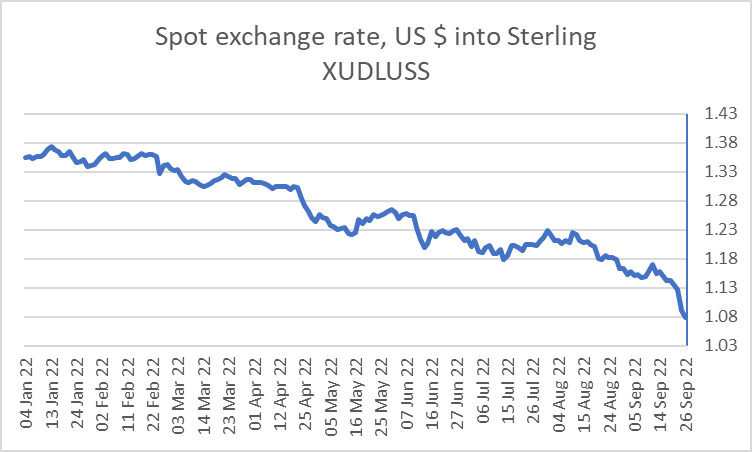
Monday 26 September – three days after the Mini-Budget – saw the weakest pound on record against the USD (£1:$1.03). The slow decline has been happening for a few months – a combination of a strengthening US economy, persistent inflation, and weaker than expected sales figures last month – but the enormous tax cuts announced last week were the final straw.


In response to doubts about the government’s plan, investors rapidly sold off their GBP currency, reducing its overall value.


A weaker pound is bad for businesses who rely on importing goods from overseas, or customers purchasing from businesses abroad – these costs will go up purely from a currency conversion point of view. It will also add further pressure to gas and fuel prices, which are largely imported, as well as food (almost half the UK’s food is imported). Anything purchased in the UK containing parts from overseas will also be prone to price rises.

Source: Bank of England


Andrew Bailey – Governor of the Bank of England – has indicated we could be facing further significant rises in interest rates to combat inflation, particularly given the recent tax announcements. While no further increases are set to happen before November, the message is clear: the BOE will increase rates by “as much as is needed”, adding more pressure on individuals and businesses holding variable rate debt.


Wages aren’t keeping pace with inflation


The summer months have been peppered with strikes, from Barristers to Postal Workers, all demanding higher pay. Wages have not kept up with price inflation, leaving workers across most industries facing real-term pay cuts.


It’s argued rising wage costs add pressure to business profit margins. Businesses respond by increasing their prices to cover the additional costs, adding fuel to the burning fire of inflation. Wage restraint is encouraged by top policymakers trying to avoid this, but it leaves households and consumers short of money and facing, in some cases, extreme hardship. The result? Less spending on non-essential items, and often even on essential products.


Late customer payments add extra pressure to cash flows


Xero – the accountancy software developed with small businesses in mind – publishes monthly Business Insight Reports using anonymised data from its small business. They aim to use this information to improve their understanding of the sector and its current trends.


The most recent report supports the decline in sales we’ve already covered but also shows a trend towards longer waits time for small businesses waiting to be paid. This is the fourth successive increase, with average payment times now at 30.4 days – breaching the traditional 30-day credit term. On average, payments are received 8.3 days beyond their due date.


Efficient cash flows are essential to small businesses, which often have less wiggle room compared to larger companies. Until the cold hard cash is received, it’s difficult to reinvest back into the business. Late payments pile the pressure onto cash flows and could have a domino effect resulting in late creditor payments and supply chain problems.


But it isn’t all doom and gloom….


Poor sales figures are undeniably bad for businesses, but some of the driving factors could help some businesses, at least in the short term.


A weak pound could increase exports


A weak pound is generally undesirable, but it is an opportunity for businesses that export overseas. Poorer GBP exchange rates reduce the relative price of UK products to overseas nations, making exports more attractive. Ultimately this can boost sales. In July 2022, UK exports increased by 7%, driven many by exports to the EU.


Inflation remains high but decreased in August


Inflation soared during 2022 but shrank by 0.2 percentage points in August 2022 to 9.9% from 10.1% in July. The decline – partly due to lower fuel costs – could be short-lived, as the BOE predicts a peak of 11% next month, down from its initial projection of 13%. Until we see a sustained decrease in inflation, consumers will continue to be prudent with their disposable income.


No one can predict the future


We’re facing yet another period of uncertainty as we navigate the early days of the new government, and the economy gets to grips with their new policies. Many of the announcements aim to increase long-term investment in the UK, but this might not be enough for businesses struggling to meet their sales targets now.


Sources

(Viewed 27 September 2022)


Lewis R 2022, Retail sales, Great Britain: August 2022, Office for National Statistics


Anon 2021, UK Small Business Statistics, Federation of Small Businesses viewed


Morris S & Bhunjun A 2022, What is a recession? UK output falls and interest rates go up. Evening Standard


Anon 2022, The British Independent Retailers Association has said the latest sales figure decline is evidence the cost of living crisis has crushed consumer confidence, British Independent Retailers Association


Simpson E 2022, Aldi boss: shoppers are switching in their droves, BBC News


Department for Business, Energy, and Industrial Strategy 2022, Energy bills support factsheet, GOV.UK


HM Treasury 2022, The growth plan 2022, GOV.UK


Anon 2022, Pound hits record low after tax cut plans, BBC


Department for Environment, Food, and Rural Affairs, United Kingdom Food Security Report 2021: Theme 2: UK Food Supply Sources, GOV.UK


Xero Small Business Insights 2022, Xero Small Business Index United Kingdom Monthly Update, Xero


Donnarumma H 2022, UK trade: July 2022, Office for National Statistics


Gooding P 2022, Consumer price inflation, UK: August 2022, Office for National Statistics


Michael A & Howard L 2022, Inflation, interest rates & economy: Bank of England takes urgent action to prop up gilt market, Forbes Advisor


Categories
Business Practice

Work-life balance: is it possible for small business owners?

  • Post author By Lesley Slack
  • Post date September 15, 2022
  • No Comments on Work-life balance: is it possible for small business owners?


Running a business takes grit, and about a third of business owners (who might have initially set up their own business in the hope of ultimate flexibility) have found themselves working more than 50 hours each week – a quarter over 60 hours – far exceeding the hours their employees are working.


Finding that elusive work-life balance is a challenge for business owners. Constantly being torn between work and personal commitments is exhausting, and it’s easy to feel like you’re failing to succeed in either.


Owning a business is undeniably gruelling, and while there are things you can do to streamline your productivity, you’ll never negate the need for hard work. Therefore, it’s important to find an equilibrium between work and personal life that’s maintainable – or risk full-blown burnout.


External factors have piled unprecedented pressure on business owners


The last two years have been eventful, to say the least. Starting in January 2020 with our departure from the EU, then straight into a pandemic, record-breaking inflation, cost-of-living crisis, looming recession, new Prime Minister, and the recent tragic loss of Queen Elizabeth II. It’s certainly a period for the history books.


It’s been tough for everyone, but small business owners face many of these challenges twice over; once in their personal lives and a second time from a business perspective.


Research carried out by IWOCA partnered with Mental Health UK found that four in five small business report poor mental health – a staggering proportion. Mental health struggles are reported to have worsened during the pandemic – with over one-third having panic attacks during this time – and are more prominent in women.


Burnout is harmful to physical and mental health


Stressful days are par for the course for business owners. The pull of work demands is ever-present, making it difficult to ever fully switch off. While a little bit of stress can actually boost performance, sustained stress is detrimental to our physical and mental health.


Burnout has been identified by the World Health Organization as an ‘occupational phenomenon’, whereby unmanaged workplace stress results in exhaustion, negative feelings towards a job and reduced professional efficacy.


There’s a misconception in modern society that success equates to long arduous hours at the sacrifice of our health and personal life. But since the start of the pandemic, there has been a shift in workers’ priorities that has partly driven widespread resignation across the globe. Microsoft’s 2022 survey claims that over half of employees are now more likely to prioritise their well-being over work than compared to pre-COVID-19.


But business owners generally don’t have the option to leave as readily as employees do, and also have the additional pressure of business success or failure hanging over them. Entrepreneur burnout – though not officially recognised as a separate disorder by the WHO but well documented in the media – refers to burnout affecting business owners. Often considered more passionate and driven than the general population, business owners carry the burden of responsibility for their business’s success and the livelihoods of their employees. They may eventually come to identify their work success as self-worth, which invariably causes problems if business performance takes a downturn.


The detrimental effects of burnout on health are well-documented. Research studies have identified burnout as a predictor of several physical illnesses, including high cholesterol, type 2 diabetes, heart disease, musculoskeletal pain, fatigue, headaches, gastrointestinal problems, breathing issues, injury, and death before age 45. Unfortunately, the same research linked burnout to psychological problems, including (but not limited) to insomnia and depression. (Your blood pressure might have gone up a notch just reading this paragraph).


The signs of burnout


To avoid burnout, it’s essential to recognise the early signs of stress and seek support before it escalates to a crisis point.


The road to burnout consists of a progressive constellation of constantly trying to prove your worth, hard work, inability to switch off, self-neglect, withdrawal, depersonalisation, and depression, ultimately culminating in full-blown burnout: mental and physical collapse.  


Ways to improve your work-life balance


Finding a work-life balance is not necessarily about working less, but about finding harmony between the two. One will inevitably take priority over the other at some points, and it’s finding ways to manage these times that will ease the pressure.


Reflect on the bigger picture


We often reflect on the things important to us during big life events, but reflection should form a continuous process rather than existing as isolated episodes when the need arises. When work or failure to find a sustainable work-life balance becomes overwhelming, it’s important to understand the reasons why.


Certain times will inevitably be busier than others – such as year-end closing books or leading up to big project deadlines – and simply acknowledging the finite nature of these tribulations could help. But if the problem is prolonged, if you’re constantly working with no end in sight, identifying why is the first step to dealing with it.


Acknowledge that sometimes work will take priority, and personal life others. Clear communication with colleagues, family and friends during these times sets out reasonable expectations and is key to avoiding tension.


Hire people you trust


Delegation is an effective way of reducing your workload by offloading non-mission-critical tasks to others. Some things simply can’t be delegated – business growth plans and strategy or having dinner with your family – and these are the things you should focus your time on.


Ensure the people you hire can be trusted to carry the torch when you need to take a break. You will inevitably need to take time away from the business at some point; make your life easier by not having to worry about it (as much) when you need to be focused on other things.


To segregate work and personal life, or not?


Many advocate completely separating work and family life, simply switching off from the business when you leave. Others claim blending the two (telling family stories at work, sharing triumphs and failures with the children) makes it easier to reach a sustainable equilibrium – that they can exist together symbiotically.


Whatever your feelings on this, most will agree that having some ‘digital detox’ time, without work messages and emails coming through to your phone at all hours is healthy. Set ‘do not disturb’ for a few hours or take it to the extreme (as one person I know does) and have two phones – one for general use and the other ‘holiday’ use (only his mum, wife and son have the number to that phone and the general use one is left at home whenever he goes away or needs a break).


Commit time to exercise


The health benefits of exercise are extensively documented in scientific literature. Exercise is linked to a vast array of physical and mental health benefits: lower risk of heart disease, type 2 diabetes and cancer, an almost one-third reduction in the risk of early death, improved mood, better sleep, and a lower risk of clinical depression.


Research studies have also found a direct role of exercise in the prevention of workplace burnout.


Consider whether your business processes could be optimised by technology or outsourcing


When it comes to software to improve productivity or streamline business processes there are a lot of options available. Software that automates administrative tasks and invoice payments, or manages employee expenses and client relationships, could potentially help your business run more efficiently.


Similarly, outsourcing certain roles or even whole departments could free up valuable time to focus on other pressing aspects of your business, or to even out your work-life balance. 


More Than Accountants offer comprehensive bookkeeping, financial reporting, and tax advisory services for a fixed monthly fee, all of which are customised to your business. Outsourcing to More Than Accountants could save you valuable time and money, without compromising the quality of your business’s finance function. Get in touch to discuss how More Than Accountants can help.


Improve your productivity by being kind to yourself

Failure to achieve a sustainable work-life balance leads to stress and burnout. In addition to the physical and mental consequences discussed above, we also know these are linked to reduced productivity, which is exactly what business owners don’t need during their most pressured times. Reducing stress and paying more attention to your work-life balance could work wonders for your productivity, as well as your health.


Be kind to yourself, accept that you are human, and seek ways to find (or at least move closer to) that ever-elusive work-life balance.


Sources


Callahan T 2006, Business owners work twice as much as employees, survey finds. Inc., viewed 11 September 2022, https://www.inc.com/news/articles/200604/overworked.html


Salvagiono DAJ et al. Physical, psychological and occupational consequences of job burnout: a systematic review of prospective studies. PLoS One. 2017;12(10):e0185781 https://journals.plos.org/plosone/article?id=10.1371/journal.pone.0185781


Emms C 2021, Four in five small business owners experience poor mental health. Iwoca, viewed 12 September 2022, https://www.iwoca.co.uk/news/mental-health-small-business-owners/


Departmental news 2019, Burn-out am “occupational phenomenon”: International Classification of Diseases. World Health Organization, viewed 12 September 2022 https://www.who.int/news/item/28-05-2019-burn-out-an-occupational-phenomenon-international-classification-of-diseases


Anon 2022, Great expectations: making hybrid work work, Microsoft, viewed 12 September 2022 https://www.microsoft.com/en-us/worklab/work-trend-index/

Anon 2021, Benefits of exercise, NHS, viewed 12 September 2022, https://www.nhs.uk/live-well/exercise/exercise-health-benefits/


Bretland RJ & Thorsteinsson EB. Reducing workplace burnout: the relative benefits of cardiovascular and resistance exercise. PeerJ, 2015;3:e891 https://www.ncbi.nlm.nih.gov/pmc/articles/PMC439 3815/


Peek S 2022, Stress and productivity: what the numbers say, Business.com, viewed 12 September 2022, https://www.business.com/articles/stress-and-productivity-what-the-numbers-say/


Categories
Business Practice

Renewable energy: a small business perspective

  • Post author By Lesley Slack
  • Post date August 31, 2022

  • No Comments on Renewable energy: a small business perspective


With record-breaking temperatures and 40-year high inflation, it’s unsurprising that businesses across the country are rethinking their energy strategies.


On 19 July 2022, the UK recorded a daytime temperature of 40.3°C in Coningsby, Lincolnshire, making it the hottest day on record. The night-time record was also broken, reaching 25.8°C in Kenley, Surrey.


Climate change is driving the recurrent hotter, longer heat waves, which are expected to become commonplace as the atmosphere continues to heat. We know there is an indisputable link between rising global temperatures and burning fossil fuels, and attention across the world is turning to renewable energy as a way to slow down the roasting of our planet.


The UK aims to establish a power system that generates zero carbon in its bid to be net zero by 2050. Renewable energy – wind, solar, hydroelectric, and bioenergy – is central to achieving this. 2020 was the first year that more electricity was generated from renewables than any other source (43%), but natural gas remains the predominant source of energy generation, releasing a stream of greenhouse gases as it burns.


Small businesses worried about the climate (and their profit margin) are looking to renewable energy for options.


According to 2017 research, 72% of SMEs are keen to commit to green energy. Moving to greener energy offers potential cost savings and a chance to renew corporate responsibility initiatives, improving the business’s attractiveness to both consumers and investors.


Rising energy costs are increasing business expenses


Businesses aren’t subject to the energy price cap but still face higher energy bills because of rising energy costs. They are also victims of rising inflation, driven in no small part by the spiralling energy prices. One megawatt-hour of electricity is £600 – 12 times higher than the decade average.


Small business owners and employees, however, will personally face the full brunt of the price cap increases. Currently sitting at £1,971, the price cap will rise to £3,549 in October, then is expected to reach around £4,650 in January 2023. Some sources even predict that further supply problems (restrictions from Russia, closures of French nuclear plants, and droughts impairing power plant cooling systems) could push the cap over £5,500 next year.


Supplies could be unpredictable this winter


Part of the problem driving up energy prices is supply unpredictability.


The UK’s energy markets are linked to Europe, which traditionally receives about 40% of its gas from Russia. The Russian invasion of Ukraine on 24 February was met with tough western sanctions, and – in apparent response – supplies to the continent were restricted. Bloomberg reported earlier in the month that the UK was due to receive a shipment of liquefied natural gas from Australia – the first in six years: an indication of the impact of current shortages.


With winter approaching the UK’s energy requirements will increase, as businesses and households need longer periods of indoor light and heat. Long periods of cold weather could feasibly result in blackouts in early 2023, according to the government’s worst-case scenario.  In combination with reduced supplies from Norway (low water levels have limited the supply of hydroelectric power available for export) and France, we could be faced with shortages this winter.


The result for businesses? Disruption (and loss of money).


What are the options for small businesses interested in renewables?

Possible options for businesses keen to go green include subscribing to a green energy tariff and investing in commercial wind turbines or solar panels. Wind turbines and solar panels – in addition to reducing your business’s carbon footprint and reducing monthly energy bills – offer a contingent supply in the case of electricity shortages or grid maintenance safety shutdowns.


Green tariffs


Green tariffs supply electricity generated from renewable sources (though some may not be 100% green so it’s important to check this with any potential suppliers). Switching to a green tariff reduces the global demand for fossil fuels, in turn reducing carbon emissions and negating the need for new mines and oil rigs.


Wind turbines for your business


In Q4 2021 wind power generated 26% of the UK’s total electricity. Wind turbines are available to businesses either pole-mounted (free-standing) or building-mounted and can often be installed without planning permission. Prices vary depending on the size and energy generation and range from £1,500 for a small roof-mounted turbine generating 1,750-kilowatt hours (kWh) per year to £34,000 for a large pole-mounted one generating 9,000 kWh per year.


Grants may be available to help local businesses looking to improve their energy efficiency and by signing a Climate Change Agreement (CCA) with the Environment Agency, you’ll be eligible for a discount on the Climate Change Levy (CCL; a tax added to electricity and fuel bills).


The downsides are restrictions on use in less windy areas (an average windspeed of a minimum of 5m/s is needed), the need for an area free of obstructions, maintenance costs, and potentially higher business rates (renewable energy items are included as assets in business rate valuation).


More information on wind turbines for businesses can be found here.


Commercial solar panels


Solar panels are increasing in popularity in the UK: we are leading the way in Europe when it comes to installing them. Google searches for solar panels were 316% higher in March this year than the five-year average, and increased again over the summer amid the heatwave.


They function during daylight hours (they convert light rather than heat to energy), which – conveniently – aligns with business hours, and are surprisingly effective despite the UK’s generally mild weather. The energy generated flows out in real time unless the system has a battery to store it.


Like wind turbines, solar panels have significant upfront costs – on average between £16,000 and £70,000 for small and medium businesses. But due to competition and better accessibility to technology, this is expected to drop by half over the next decade. Maintenance is straightforward and only needs to be done every four to six years. They last around 25 years and reduce monthly energy bills for this time as well as your business’s carbon footprint.


To incentivise commercial solar panel installation, the government set up an initiative in 2020 – the Smart Export Guarantee (SEG) – which allows businesses to sell excess energy to their energy supplier. A smart meter is needed to monitor how much is sold. Public sector businesses may also benefit from interest-free capital from Salix Funding, a body funded by the Department of Business, Energy, and Industrial Strategy (BEIS) to improve energy efficiency and reduce emissions.


Disadvantages of commercial solar panels include requiring planning permission before having them installed, the effect on business rates (as with wind turbines), and the need for regular cleaning (panels are more efficient if dust is regularly removed).


From a residential point of view, solar panels could save households several hundreds of pounds each year, taking the edge (very slightly) off the rising energy cap. The upfront costs are the biggest put-off, but prices have dropped significantly over the last few years. The market value of a residential property can be increased by solar panels and by selling surplus energy to the SEG.


Improve your corporate social responsibility

Corporate responsibility is key to a better corporate image. Robust initiatives strengthen reputation, boost consumer footfall, attract investors, attract new customers (particularly younger generations), and retain employees, all in addition to reducing your costs and playing your part in saving the planet.


Ultimately, fossil fuels are finite resources. Wind, solar, and water are not depleted by energy generation, and will persist long after fossil fuels have run out.


Going green now is not only a step in the right direction for the climate but is also a means to future-proof your business’s energy strategy.


Sources


Press Office 2022, Record breaking temperatures for the UK, Met Office, viewed 22 August 2022, Record breaking temperatures for the UK – Met Office


Ashworth J 2022, 40°C heatwaves could happen every few years because of climate change, National History Museum, viewed 22 August 2022, 40⁰C heatwaves could happen every few years because of climate change | Natural History Museum (nhm.ac.uk)


ClientEarth Communications, Fossil fuels and climate change: the facts, ClientEarth, viewed 22 August 2022, Fossil fuels and climate change: the facts | ClientEarth


Anon 2022, Energy explained, National Grid, viewed 22 August 2022, How much of the UK’s energy is renewable? | National Grid Group


Gough O 2017, An SME guide to renewable energy, Smallbusiness.co.uk, viewed 22 August 2022, A small business guide to renewable electricity in the UK


Anon 2022, Supply fears push up gas prices to record level, Business Matters, viewed 22 August 2022, Supply fears push up gas prices to record level (bmmagazine.co.uk)


Environment Agency, Climate Change Agreement, GOV.UK, viewed 22 August 2022, Climate change agreements – GOV.UK (www.gov.uk)


Anon 2022, Get a wind turbine, Zero Carbon Business, viewed 22 August 2022, Get a wind turbine – Zero Carbon Business


Anon 2020, Why are commercial solar panels so popular with UK businesses? Low Carbon Energy, viewed 22 August 2022, Why are commercial solar panels so popular with UK businesses? (lowcarbonenergy.co)


Anon 2022, Google searches for solar panels increase by 300 per cent as cost of living and energy crises hit, Business Matters, viewed 22 August 2022, Google searches for solar panels increase by 300 per cent as cost of living and energy crises hit (bmmagazine.co.uk)


Anon 2019, 2019 global energy trends: Statkraft’s low emissions scenario, Statkraft, viewed 22 August 2022, https://www.statkraft.com/globalassets/1-statkraft-public/lavutslipsscenario/low-emissions-scenario-2019.pdf/


Categories
Business Practice

Should I outsource my finance function?

  • Post author By Lesley Slack
  • Post date August 15, 2022
  • No Comments on Should I outsource my finance function?


The popularity of outsourcing has boomed in recent decades. Driven by a desire to streamline processes and access expertise without having to cultivate it from scratch, more and more UK businesses are taking the plunge and outsourcing (sometimes whole departments) – freeing up time to focus on other aspects of the business.


Financial management can be tedious work and can take up an inordinate amount of time – particularly for new and growing businesses. But getting your accounts in shape is certainly something that needs to be done correctly to avoid non-compliance issues and HMRC penalties.


Outsourcing was used as far back as the 18th century (though it’s probably been around in some form or other for many millennia); ships travelling the oceans often experienced significant crew losses, and gaps were filled by people picked up across the globe. Eventually, the widespread availability of seafarers meant crews could be recruited for less money – reducing the cost of hiring a crew.


More recently, it gained momentum in the late 1980s, when it was formally recognised as a business strategy. In the 1990s, support service outsourcing grew as businesses tried to reduce costs without detracting from the quality of the core business.


Now, outsourcing is increasingly viewed as a strategic partnership, aiming to achieve excellent results through carefully planned collaborations.


Outsourcing is popular in the UK


The UK is a proliferative outsourcer: in 2019, seven in ten UK businesses outsourced their work to third parties. Only a quarter have never used any form of it. The cited reasons vary; of companies that outsource, seven in ten do it to reduce costs, half to transform their business, and half to improve the quality of their services.


Access specific skills from anywhere

Naturally, some people have skills that are useful to others, and others are prepared to pay to use them. There is also an opportunity for someone looking for a specific set of skills – that may be widely available – to find the least expensive way to access them.


IT is currently the most readily outsourced function, with over one-third of UK businesses looking elsewhere for IT support. IT experts aren’t cheap and considering the ever-sophisticated IT networks available, and the evolving nature of cybersecurity threats, IT outsourcing is an opportunity for smaller businesses to tap into the most reliable services without having to spend a fortune developing their internal departments.


Finance, payroll, HR, and marketing are other common outsourced services. Client-facing services – such as sales and customer services – are the least likely to be externally outsourced.


The rapid acceleration of globalisation, particularly following the first few years of the COVID-19 pandemic, has made the location of employees and services irrelevant: work can be done anywhere. In keeping with this, research from Opinium and LiveArea in 2020 suggested that outsourcing would be a prominent feature of post-COVID-19 work; almost one-third of companies in the UK planned to incorporate outsourcing, to improve their agility and resilience.


Outsourcing promotes business continuity and scalability


The start of the pandemic saw chaos unfold for many businesses. Most weren’t ready for the rapid shift to remote working, which ultimately cost them a lot of money.


Outsourcing is effectively part of a contingency plan against any similar events in the future – the supplying company is already set up to deliver services from offsite and external to your network.


It also makes it possible for businesses to grow quickly without having to scale up internal functions. It may cost an expanding business more each month to outsource their work, but an incremental increase in supplier fees is unlikely to cost as much as an additional employee.


Outsourcing provides an opportunity to cut employee costs

Outsourcing removes the need to have an in-house department for that function. That’s at least one, maybe several, annual salaries your business could avoid paying. And no need to worry about annual leave – it’s all covered by your supplier.


2022 is a year of spiralling costs and inflation, paired with low unemployment and record-high job vacancies. Employers are in a weak position when it comes to retaining talent and negotiating salaries – avoiding this problem altogether is certainly attractive this year.


Access expert knowledge without paying to keep employees up to date


The cost of employee training and continued professional development completely bypasses your profit and loss when you outsource – it’s all paid for by the supplier. You can tap into a fountain of specialist knowledge knowing it is up to date and monitored (their reputation relies on it).


Stay focused on your mission


Time is the most sought-after commodity: we simply don’t have enough of it. Small business owners have a lot on their plates and offloading some of the internal support services is an excellent way to free up time to focus on building up your business strategy.


Some outsourced tasks can even directly contribute to achieving your business plan. Marketing is an area increasingly outsourced to a third party. Big data and data analytics have made it possible to develop customised marketing strategies that hit your customer base target. Seeking help from an expert can pay dividends in creating (or refreshing) a brand image.


UK or abroad?


Almost half of UK companies outsource their functions offshore.


India is a leading global outsourcing destination. It boasts a huge population and skilled talent pool, in addition to a low average salary. Hiring a software developer in India costs less than one-thirteenth of hiring one in New York. Software development and IT services are commonly outsourced to India.


Other popular destinations include the Philippines, Malaysia, Eastern Europe, and South America.  


Many overseas outsourcing companies strive to provide 24-hour services, which makes the time difference between there and the UK irrelevant. But this isn’t guaranteed, and time differences can create a challenge when it comes to communications.


The downsides


Outsourcing inevitably brings with it some loss of control. You don’t have the same opportunity to monitor third-party contractors as you do in-house employees. It can also take some time to build up a relationship and align your company’s tone of voice – particularly important when it comes to marketing.


Existing employees may well feel shunned if their position is made redundant due to outsourcing. While employee costs are often a large component of business expenses, outsourcing – particularly overseas at the expense of UK workers – could detract from an already floundering economy.


Security risks are a big factor to think about when outsourcing services. Proper GDPR agreements should be in place to protect any data and lay out the risk management plan in the event of a data breach. In general, cloud computing systems are associated with heightened security advanced and encryption techniques, but full research should be done into the systems and security measures potential suppliers have in place.


More Than Accountants can help manage your finances


Our role as a digital accounting firm probably gives away our position on this topic. We love outsourcing – so much so that we base our entire business on it.


More Than Accountants understand the incredible benefits small businesses can reap from outsourcing their finance function and are here to support your business with robust accounting services and tax advice as standard with the monthly subscription packages.


More Than Accountants offers comprehensive accounting services that can be customised to align with your business needs. Monthly or quarterly financial reporting allows provides regular actionable insight, so you can address any problems within the business before they escalate.


More Than Accountants allocate specific team members to your account, and they will liaise directly with you on any queries. Xero is our default accounting software – a cloud-based system designed with small businesses in mind, that comes with the excellent security you expect.


Fees are fixed and based on your business’ revenue and the number of transactions regularly made; they are much lower than the monthly salary cost of an in-house accountant.


Outsourcing to More Than Accountants could save you valuable time and money, without compromising on the quality of services your business needs to thrive.


Sources


Ismail N 2020, Businesses focus on outsourcing as a Covid-19 survival strategy. Information Age, viewed 8 August 2022, Businesses focus on outsourcing as a Covid-19 survival strategy (information-age.com)


Sooprayen R 2019, Seven in ten British businesses outsource to third parties. YouGov, viewed 8 August 2022, Seven in ten British businesses outsource to third parties | YouGov


Perić J 2022, Genius Outsourcing Statistics UK [2022], Cybercrew, viewed 8 August 2022, Genius Outsourcing Statistics UK [2022] (cybercrew.uk)


Anon 2022, Ultimate outsourcing statistics and reports in 2023, Outsource Accelerator, viewed 8 August 2022, Ultimate outsourcing statistics and reports in 2021 | Outsource Accelerator


Soucy L 2022, 8 top countries for outsourcing, Time Doctor, viewed 8 August 2022, 8 Top Countries for Outsourcing (2022 Edition) (timedoctor.com)


Categories
Business Practice

Does my small business need an audit?

  • Post author By Lesley Slack
  • Post date July 31, 2022
  • No Comments on Does my small business need an audit?


For most small businesses, a financial audit is a distant concern. Companies House stipulates small companies must submit annual accounts each year, but for those meeting the small company criteria, these don’t need to have been audited.


Though financial audits have a reputation for being arduous (and a period the finance department dreads each year) they offer some valuable benefits to small and large companies alike. This is why successful brands choose to pay for the cost of accountant for small business.


What is a financial audit?


The objective of an audit


A financial audit, or an external audit, is a thorough independent scrutinisation of a business’s financial statements. Its purpose is to ensure the information presented in the financial statements is a fair and accurate representation of the performance and position of the business at the end of the relevant financial year, and that the way it is presented complies with the applicable accounting standards.


Many stakeholders – customers, suppliers, employees, lenders, and shareholders – rely on financial information to guide crucial decisions: whether to invest more in the company, accept a job offer, or issue a substantial bank loan. Inaccurate information can have catastrophic consequences, if for example, a company is unable to repay a loan they were offered on the grounds of an overstated balance sheet – the bank loses money, and the company is potentially pushed into administration.


An external financial audit differs significantly from an internal audit. The latter is carried out by employees of the company (or an external consultant if no internal audit department exists) to ensure compliance with laws and regulations and to improve the efficiency of business processes. The results of an internal audit are used by management to make informed changes relating to the business.


One large misconception surrounding financial audits is that they are performed to detect fraudulent activity and all errors present within the accounts. Audits do occasionally pick up instances of fraud and other misstatements (usually only those above a materiality threshold are flagged to the client) and may discourage illegal behaviour. But detection of fraud is not a primary objective of an audit: the responsibility for deterring and picking up fraud lies firmly with the management team.


What does an audit involve?


Audits are carried out by qualified auditors, generally working within public accounting practices. Procedures are carried out on individual balances in the financial statements that are higher than a specified threshold – referred to as materiality.


Materiality is calculated for a given company using a standardised formula applied to turnover, profit, or assets held. The exact parameter used depends upon the nature of the company and is determined by the auditor during the audit planning stages. Any balances over materiality are subject to rigorous testing procedures to ascertain whether they show a fair reflection of the actual performance or position of the company.


Assets held by the company are also physically verified during the audit. Properties, for example, are viewed in person and agreed to independent valuation reports and title deeds.


Towards the end of the audit, the financial statements are reviewed as a whole, to ensure they contain all the information they need to comply with relevant legislation and accounting standards.


After completion of the audit work, once the auditors and company directors have approved the financial statements, they are signed by both parties. The final accounts include a formal audit report that confirms to readers that the financial statements have undergone a rigorous independent review, which lends credibility to the information presented.


International audit standards


The International Auditing and Assurance Standards Board (IAASB) issues standards and regular updates – International Standards of Auditing (ISAs) – that guide auditors through the work they must complete during an audit. These cover a wide range of topics, from communication with management to reporting related party transactions. Each audit firm also usually has its own audit guidance and testing approach that its auditors are trained to use.


Does my business need an audit?

Small businesses are generally exempt from statutory audits. To be considered small, at least two of the three following criteria must be met in two of the last three years:

  • an annual turnover of less than £10.2 million
  • gross assets less than £5.1 million
  • total employees less than 50.


However, even if these criteria are met, section 476 of the Companies Act allows shareholders holding 10% or more of the company shares (either as an individual or group of shareholders) to formally request an audit by writing to the company’s registered office address. The request must arrive at least one month before the end of the financial period they wish to be audited.


Some companies must undergo an audit by law. These include public companies, subsidiary companies within a group (unless they qualify for an exemption), insurance companies, and those in regulated finance or legal sectors. Many of these operate in a position of trust and require the assurance afforded by an audit. Some banks and lenders require an audit as part of their debt covenants to provide security over repayments – specifics will be set out in the loan agreement.


Charities


The thresholds for charities are slightly different to those for a private company. When a charity exceeds the following criteria, it must set up a financial audit:

  • annual income over £1 million
  • gross assets over £3.26 million and annual income over £250,000


Many charities undergo regular audits despite their size. Often, constitutional documents specify the need for an audit, or it is included in conditions set out by donors.


Other benefits of an audit


Improving business performance

A successful audit requires the audit team to have a full understanding of your business. To do this, they examine the processes and controls you have in place in relation to various areas: recording of financial information (which accounting software you use, who has access, who can post manual journals, who approves them?) cash transactions, processing of customer receipts and supplier payments, and asset acquisition and disposal.


External review of these provides an opportunity for non-bias feedback, which can highlight weaknesses or inefficiencies in your business. Addressing these could improve business performance and reduce the risk of errors (or fraud) making their way into financial information. A 2018 report from Deloitte supports this; high-quality audits were shown to create business insights, identify inefficiencies, and mitigate potential risks.


Improve credibility and increase stakeholder confidence


Proof of independent verification via an audit report lends credibility to a set of financial statements. Potential clients, investors, lenders, and suppliers are more comfortable with audited information compared to non-audited due to its higher reliability.


Preparing for a sale


Assurance over the state of a business can be useful when preparing for its sale. Audited financial information is more likely to result in a favourable selling price. Potential purchasers are inclined to agree to a price if they are comfortable that the information reflects the true (independently verified) performance of the business.


How to prepare for an audit

To set up an audit, you must first approach an accountancy firm licenced to audit. For new clients, certain checks are carried out before accepting the audit, including money laundering checks and client ID verifications. On acceptance, an engagement letter for signing will be issued that outlines the terms of the audit, and usually has an attached communications letter setting out the expected timeline and other relevant information. Often a request for information will also be provided, which includes a list of information needed to start the audit.


It is important to have all information ready by the agreed audit start date. Delays in providing it to the audit team could result in delay of the whole audit, and additional fees payable to the auditors if the delay impacts other client engagements.


How much does an audit cost?


The cost depends on the size of the business and the amount of work expected to be needed. Fees range from a few thousand for small single company audit to several tens of thousands for group audits with acquisitions and disposals to consider. The exact fee will be agreed upon before any audit work starts.


Sources


Anon 2022, Current Auditing Standards, Financial Reporting Council, viewed 26 July 2022 Auditors I Audit and Assurance I Standards and Guidance for Auditors I Current Auditing Standards I Financial Reporting Council (frc.org.uk)


Anon 2022, Audit exemption for private limited companies, GOV.UK, viewed 26 July 2022, Audit exemption for private limited companies – GOV.UK (www.gov.uk)


Anon 2019, Audit Value Survey, Deloitte, viewed 26 July 2022, Audit Value Survey | Deloitte US


Categories
Business Practice

Cash flow: keeping small business owners awake at night?

  • Post author By Lesley Slack
  • Post date July 15, 2022
  • No Comments on Cash flow: keeping small business owners awake at night?


There’s no shortage of reasons why small business owners may have trouble sleeping given the current economic climate – ongoing Brexit uncertainty, a cost-of-living crisis, 40-year-high inflation, an impending recession, and a pandemic are but a few of the challenges looming. But ultimately, many of the issues facing small business owners eventually boil down to one thing: money.


Will I earn enough? Can I keep expenses low enough to turn a profit? Will my business have the funds it needs to grow? Or even survive? Each of these weighs heavily on the minds of business owners.


Certified coins and paper money have been around since their creation in China in the seventh century BC. Even before then, it was a familiar concept; bartering with pieces of metal or other objects – such as seashells and animal skins – had been practised for millennia. Money now exists largely in terms of debits and credits; physical money is becoming almost a rarity (many of us haven’t carried a coin in years). But cash continues to drive the economy, and the timing and availability of it determine whether a business will sink or swim.


Making enough money

Revenue is largely dependent on the number of products or services sold, and the price charged for these. Depending on the maturity of the business, revenue could cause a headache for different reasons.


Building and preserving customer interest in products


New start-ups must first build up a customer base, which takes time. With so much choice already available to consumers (particularly since the ecommerce explosion in 2020), it can be difficult to achieve a foothold in the market unless you’re offering something truly innovative. This is where market research can prove vital. Detailed market research helps determine exactly what consumers need and ensures there’s a demand for what you’re selling. It also provides an opportunity (for new and established companies alike) to evaluate the competition and set a realistic price.


Retaining customers is the next challenge. Most products have low switching costs, meaning customers can shop around for the best value. Strong brands are more likely to retain customer loyalty, as well as those that nurture their customers using loyalty programmes and targeted marketing (both of which have been shown to boost spend per customer).


Some products stand the test of time – such as classic Coca-Cola, which on trying to advertise a recipe change to customers (New Coke) had to do a spectacular U-turn, removing New Coke from the shelves and reinstating the classic version after just 79 days – but others quickly fatigue. Investment in research and development could generate a new product to reignite interest in a brand. Endorsement using social media tools is also becoming a reliable strategy for boosting the popularity of products.


Organic growth is the way most small businesses expand. It is achieved through the development of internal resources, and generating higher revenue is a key component. For more details on strategies to achieve organic growth (and higher turnover), please read our blog post Growing your business: the different options.


Minimising expenses: the biggest business challenge of 2022?


Expenses feature prominently in the top concerns of business owners. Research from the Co-operative bank found increasing operating expenses to be high on the list of small business owner concerns, second only to the impact of Brexit on the economy. Notably, those results were before the 2022 cost-of-living crisis struck – the result would likely be even more poignant now.


Rising prices across the board


Fuel prices have soared since the end of COVID-19 restrictions, accelerated further by the Russian invasion of Ukraine in February this year. Most businesses have been affected to some degree by increasing fuel costs, either by more expensive logistics or an increase in supplier prices. Supply chains across the country are feeling the pressure. The rise in energy prices has also contributed to higher overheads – only domestic contracts on standard variable rate tariffs are subject to the recent price cap increases, but rising energy costs (irrespective of the price cap) will still translate to more expense for businesses.


The next issue is 40-year-high inflation and the resultant cost-of-living crisis. In PayPal’s 2022 Business of Change Report, over three-quarters of small business owners cite the rising cost of living as the biggest threat to them in the coming year. Not only do inflation and higher cost of living directly add further strain to supply chains but also necessitate salary increases to retain employees struggling with their own finances. High employee turnover is expensive, and the loss of experienced workers reduces productivity for up to 6 months while a new recruit gets up to speed (potentially costing £25,200 per new hire).


The Office For National Statistics distributes a voluntary fortnightly business survey to collect real-time information on issues affecting businesses. The results of their most recent (at the time of writing this was dated 30 June 2022), half of businesses had experienced increases in the price of goods and services compared to a month earlier. Over a third were feeling the effects of the energy price rise.


For a deeper dive into the impact of rising inflation and labour shortages, please see our earlier blog posts via the respective links.


Contingency planning


COVID-19 simmered in other parts of the world for several months before the UK experienced its full wrath in March 2020. The biggest pandemic of our lifetimes to date posed huge logistical and staffing challenges for most companies. While the last pandemic of this scale was the Spanish Flu just over a century ago in 1918, scientists predict we are likely to see another one in the fairly near future.


Bill Gates – Co-Founder of Microsoft and all-round philanthropist – predicts another outbreak within the next 20 years with the potential to escalate into a pandemic. His claims are based on increasing global travel, climate change forcing species to migrate to different areas, and invasions of natural habitats.


In March 2022, Simply Business estimated that COVID-19 had already cost small businesses over £109 billion. To prevent the same from happening again (not necessarily limited to pandemic planning, but also including other unexpected events), many businesses are drawing up contingency plans. These involve assessing the biggest risks to the business, the effect they might have, and how to prevent huge disruption in the event something unexpected does happen. This could include identifying the employees central to essential operations and diversifying supply chains to include local suppliers.


Lenders supporting small businesses

Small and medium businesses (SMEs) are recognised for their central role in the economy: they account for three-fifths of employment and over half of turnover in the private sector. Many banks have launched initiatives to help SMEs via their lending funds – HSBC does so annually. Their 2022 fund is worth £15 billion and is intended to support employment and growth opportunities.


It comes at a time when successful finance applications are at a low, signifying less lending to smaller businesses. Only 9% of small businesses applied for finance (a figure that has been falling for over a year and a half) and only 43% were approved in the first quarter of 2022, according to the FSB’s Small Business Index.


Loans from other lenders are also available – a summary from Small Business Prices.co.uk can be viewed here.  


More Than Accountants can help you with financial reporting and analysis


Staying on top of your accounts and financial reporting is pivotal to reducing unnecessary expense and identifying areas that can be streamlined to improve efficiency.


More Than Accountants include quarterly (or monthly, depending on your individual requirements) reporting in their accounting packages, giving you an opportunity to take timely, decisive action on suboptimal performance. They also include tax advice as standard, which can reduce your liability by accessing the various reliefs available to you.


Prioritise your well-being


The stress of having a small business in such trying times can take a toll on mental health.


A survey published by Mental Health UK and iwoca (small business lender) found that four in five business owners suffer episodes of poor mental health several times each year. The pandemic has added to existing struggles, culminating in many business owners suffering panic attacks and episodes of depression. In their survey, half had never accessed mental health support services.


Help is available if the stress of running a business is becoming too much. Taking some time to rest or spending time with friends and family may go a long way to helping with stress. For those who need further support, NHS Choices offer advice on mental health and how to access additional services.


Sources


Tikkanen A. A brief (and fascinating) history of money. Britannica, viewed 7 July 2022 A Brief (and Fascinating) History of Money | Britannica


Ritschel C 2019, New coke: Coca-Cola bringing back controversial drink in honour of Stranger Things, Independent, viewed 6 July 2022 New Coke: Coca-Cola bringing back controversial drink in honour of Stranger Things | The Independent | The Independent


Spicer S 2019, Business challenges for UK small to medium companies. Smallbusiness.co.uk, viewed 6 July 2022 Business challenges for UK small to medium sized companies – Small Business UK


PayPal Author 2022, Business of change: wellness and empowerment report 2022, PayPal, viewed 7 July 2022, Business of change report 2022 | wellness & empowerment (paypal.com)


Brignall M 2021, ‘The great resignation’: almost one in four UK workers planning job change. The Guardian, viewed 7 July 2022 ‘The Great Resignation’: almost one in four UK workers planning job change | Work & careers | The Guardian


Hopson E 2022, Business insights and impact on the UK economy: 30 June 2022, viewed 7 July 2022, Business insights and impact on the UK economy – Office for National Statistics (ons.gov.uk)


Spiralet T 2022, Bill Gates warns another global pandemic to hit within twenty years, Express, viewed 8 July 2022 Bill Gates warns of another global pandemic in the next twenty years | World | News | Express.co.uk


Smith C 2022, Cost of Covid-19 to small business now exceeds £109 billion, Simply Business, viewed 8 July 2022 How much did Covid-19 cost small businesses? (simplybusiness.co.uk)


Anon 2021, UK small business statistics, FSB, viewed 7 July 2022 UK Small Business Statistics | FSB, The Federation of Small Businesses


Anon 2022, HSBC launches £15BN fund to help UK SMEs and their local economies, Business Matters, viewed 8 July 2022 HSBC Launches £15BN fund to help UK SMEs and their local economies (bmmagazine.co.uk)


Anon 2022, FSB Voice of Small Business Index, Quarter 1 2022, Federation of Small Businesses, vied 8 July 2022 FSB Voice of Small Business Index, Quarter 1, 2022 | FSB, The Federation of Small Businesses


Anon 2022, Top 25 business loans: compare lenders from £1k to £10m+, Small Business Prices.co.uk, viewed 8 July 2022, Top 25 Business Loans: Compare Lenders From £1k to £10M+ – SmallBusinessPrices.co.uk


Anon 2021, Four in five small business owners tell us they’re experiencing poor mental health, Mental Health UK, viewed 7 July 2022 Four in five small business owners tell us they’re experiencing poor mental health – Mental Health UK (mentalhealth-uk.org)


Anon 2022, Mental Health, NHS, viewed 9 July 2022, Mental health – NHS (www.nhs.uk)


Categories
Business Practice

Small businesses are at high risk of cybercrime

  • Post author By Lesley Slack
  • Post date June 30, 2022
  • No Comments on Small businesses are at high risk of cybercrime


Small businesses are prime targets for cybercrime. This comes as a surprise to many small business owners, who often think cybercriminals focus their energy on infiltrating larger organisations. But a combination of weak cybersecurity systems, vulnerable IT infrastructures, and lack of employee training could leave small businesses susceptible to devastating attacks.


The 2022 Cyberthreat Defense Report shows that over eight in ten businesses in the UK were victim to at least one successful attack in the 12 months preceding its publication. According to GOV.UK statistics, medium and large businesses are more frequently targeted (companies with more employees offer more entry points to those looking for a way in), but small businesses within supply chains are often the means to access the networks of larger organisations.


A higher number of employees working remotely has also left companies vulnerable to attack; those rushing to implement work from home technologies in response to COVID-19 restrictions in 2020 may well have unrecognised weaknesses in their networks, waiting to be exploited by hackers.


The most common types of cyberattack

Cyberattacks are actions that target a computer or network to change, destroy, or steal data. Sometimes they simply cause disruption, and harm the ability of the victim’s IT network to function normally. They may consist of data theft (such as misappropriation of customer data, financial information, or business strategic information) or digital vandalism, which aims to inflict damage to the network in some way.


Ransomware attacks


A ransomware attack involves taking data hostage using a virus installed illegally onto a computer or IT network. Criminals demand a payment in exchange for releasing the information. In 2021, over three quarters of UK businesses were victims of ransomware, and more than eight in ten of these paid the attackers to release their information.


Phishing


Emails containing malicious links that, when clicked on, provide an opportunity for cybercriminals to gain access to a computer, are the most common type of cyberattack. In 2021, over 90% of UK businesses fell victim to a phishing scam. Emails are sent out indiscriminately and in bulk with the hope that employees click on the links within. They often closely resemble real company emails, making it difficult to distinguish them from legitimate communications.


Man-in-the-middle attacks


It’s possible for cybercriminals to position themselves in the centre of communications between two parties (unbeknownst to them), and effectively spy on the data shared between them. When an email is sent, it is intercepted (and sometimes modified) before it reaches its intended recipient. Companies that use strong encryption processes or VPNs are less vulnerable to these types of attack.


Denial of service


Denial of service attacks prevent genuine users from accessing services by overwhelming the system with illegitimate requests. The site must respond to each fake request, which drains its ability to respond to real users and can result in complete shutdown. Ultimately a business will experience loss of revenue (which is particularly problematic for those reliant on ecommerce channels), and high expenses to bring the site back to normal function


Attacks on character or business reputation


Hackers that gain access to a website or social media account can cause huge disruption by changing passwords and modifying the information therein. This could materialise as attacks on character or culminate in reputational damage to the business – particularly if the updated content is offensive. It also leaves sensitive data open for hackers to access, which could result in a GDPR breach.


How much does cybercrime cost a business?


The cost to a business can be high; not only in a monetary sense but also through the detrimental effect on reputation and consumer confidence. Money, data, and assets can all be lost during an attack. According to GOV.UK, the proportion of businesses experiencing negative outcomes after an attack has reduced over the last few years, likely the result of better basic cybersecurity measures following the introduction of GDPR regulations in 2018.


Overall, the cost can be catastrophic for small businesses.


Cost of repairing the damage


Time and money must be spent repairing any damage caused by a cybersecurity breach. While the actual average cost of this varies depending on the source (£8,460 per GOV.UK, £25,700 per a 2019 World Economic Forum article) it is likely to be substantial to a small business. A full investigation into how the breach happened is necessary, and further money spent on a solution. Many small businesses will need the help of external cybersecurity experts for this.


Revenue lost while systems are offline for repair and customers lost as a direct result of the breach both reduce profit.


Reputational damage


Many years of building up a strong brand identity can all be lost in an instant following a cyberattack; customer trust may never recover.


Larger companies often feature in the media following cyber incidences – such as British Airlines, victim to a cyberattack in 2018 where sensitive data of 429,612 staff and customers were accessed – and seem to bounce back fairly unscathed; for smaller businesses with a modest customer base this can be much harder.


Asset theft


Access to bank account information and credit details can lead to theft of funds from the business. Banks are obligated to refund money stolen via fraud from consumer accounts but may not necessarily cover the cost of theft from a business account. Those that do may carry out lengthy investigations before any cash can be returned, impacting a business’s immediate cash flows.


Litigation costs and compensation to data subjects


Fines for GDPR breaches can be significant. In the example above, British Airlines were dealt a £20 million fine for its poor security measures. Though small businesses are unlikely to face a fine of this scale, failure to implement adequate security measures – particularly in relation to client data – could result in a substantial fine if a breach were to occur.


Small businesses are vulnerable


Small businesses often lack the resources to fund elaborate cybersecurity systems, leaving them vulnerable to external attack. They may also lack robust cybersecurity training programmes, increasing the risk of an employee clicking on a malicious link. Large companies are probably more frequently attacked, but better security improves their chances of detecting and preventing it.


Smaller businesses are less likely to appoint a dedicated IT information security officer. This means the person responsible for IT security is unlikely to be an expert, and IT systems may not be entirely up to date.


Paucity of regular data back-ups means loss of data could severely disrupt business continuity in the event of an attack. Disaster recovery may not be a priority for smaller businesses who aren’t expecting to be targeted by cybercriminals.


Recent global events have also increased the cybersecurity risks for businesses. Since the start of the COVID-19 pandemic, a large proportion of employees have worked remotely. This creates more potential weaknesses for criminals to manipulate. Many companies do not use two factor authentication, and unsecured home wi-fi networks put communications at risk. The Russian invasion of Ukraine and the West’s unity against it could also result in a rise in cyberattacks from overseas.


Ways to improve cybersecurity

Employee awareness training, regular system back-ups, security testing (penetration testing simulates an attack to ensure security systems are working as expected), strong passwords, two-factor authentication, and real-time monitoring of networks are all key to improving security. Many small businesses do not have the internal resources to implement all of these themselves, and often need help from an external expert.


The GCA Cybersecurity Toolkit provides free cybersecurity advice to encourage organisations to reduce their cyber risk. It gives small businesses an opportunity to improve their cybersecurity using advice from world-leading experts, without breaking the bank.


Cloud systems have become popular in recent years due to better accessibility of data to remote workers. Increased security is a prominent feature of cloud-based accounting systems; cloud providers invest in cybersecurity and data encryption so that information can be stored securely. Data is automatically backed-up to the cloud, which promotes business continuity and offers a safety net as part of a business recovery plan.


More than Accountants use Xero – a cloud-based accounting software system designed with small businesses in mind – to manage all client accounts. If you are interested in hearing more about how we can help, please get in touch.


The risk is real


Small businesses may be attacked by cybercriminals as a primary target, or to gain access to larger companies via their supply chain. The size of small businesses may mean security is suboptimal, and the costs of an attack could be substantial. The statistics speak for themselves, and most businesses should expect to be the victim of a cybercrime at some point. Preparation is therefore key to minimise the financial impact and business disruption when it does happen.


Sources


Anon 2022, 2022 Cyberthreat defense report, CyberEdge Group, viewed 21 June 2022, CyberEdge-2021-CDR-Report-v10–ISC2-Edition.ashx


Anon 2021, Official statistics: Cybersecurity breaches survey 2021, GOV.UK, viewed 21 June 2022 Cyber Security Breaches Survey 2021 – GOV.UK (www.gov.uk)


Jones C 2022, More than 80% of UK businesses paid ransomware demands in 2021, ITPro, viewed 22 June 2022, 80% of UK businesses paid ransomware demands in 2021 | IT PRO


Media Centre 2020, ICO fines British Airways £20m for data breach affecting more than 400,000 customers, ICO, viewed 22 June 2022, ICO fines British Airways £20m for data breach affecting more than 400,000 customers | ICO


Jordan A & Bates A 2019, Helping small businesses fight cybercrime benefits the global ecosystem, World Economic Forum, viewed 22 June 2022, Helping small businesses fight cybercrime benefits the global ecosystem | World Economic Forum (weforum.org)


Rose A 2022, How conflict in Ukraine could revolutionize the ransomware threat. Proofpoint, viewed 22 June 2022, How Conflict in Ukraine Could Revolutionize the Ransomware Threat | Proofpoint UK


GCA 2022, Free cybersecurity tools to secure your organization. GCA Cybersecurity Toolkit, viewed 22 June 2022 GCA Cybersecurity Toolkit Home – GCA Cybersecurity Toolkit | Tools and Resources to Improve Your Cyber Defenses (gcatoolkit.org)

  • Tags Small Business
  • Tags Small Business

Categories
Business Practice

Practical considerations when setting up a new business in the UK

  • Post author By Lesley Slack
  • Post date June 15, 2022
  • No Comments on Practical considerations when setting up a new business in the UK


There are hundreds (possibly thousands) of articles on the internet containing checklists for ‘steps to start your business’. While these are great, they are often generic, starting with ‘choose your business idea’ and ‘do your research’. While we agree that both are good nuggets of advice for someone in the very early stages, we’re going to assume you’ve already nailed down what your business is going to do and instead focus on the nitty gritty practical things you need to think about when setting up a new business in the UK.


The last five or so years have been complicated for those wishing to set up a business. Given the uncertainty surrounding future business conditions following the outcome of the 2016 Brexit referendum (and the difficulties reaching a deal with the EU), an unforeseen pandemic halting the economy for the best part of two years, forty-year high inflation and a cost-of-living crisis, the thought of starting a new business could make some tremble at the knees. But 2021 saw the launch of 810,316 new businesses – the highest number on record – filling space in the market left by those not surviving the pandemic and making the most of the economy reopening as COVID-19 restrictions eased. There are currently 5.5 million small businesses in the UK; micro and small businesses (up to 49 employees) comprise 99.4% of all UK businesses.


A lot of preparation is required before launching a new business. Around 1 in 5 new start-ups fail within a year; planning is essential to get off to the best start possible.


Deciding legal structure and business name


New businesses are set up as either a sole trader, limited company, or partnership, depending on how many people are involved and desire to separate personal and business assets.


Sole trader


In 2021, 15% of businesses were run by sole traders. Sole traders are self-employed and entitled to keep all profits (after tax) generated by their business. They are liable for all expenses incurred, and for losses made by the business. There is no distinction between personal and business assets, and large business losses could have serious financial implications on the sole trader’s personal finances.


Registration as a sole trader is done via the GOV.UK website. On registering for self-assessment, you become recognised as self-employed and are allocated a Unique Tax Reference (UTR) number. This allows you to complete an annual tax return.


As business grows, sole traders may opt to set up a company instead. Limited companies pay corporation tax, which is currently set at 19% of taxable profit – lower than rates of income tax payable by sole traders on profits after deduction of eligible expenses and the personal allowance (tax year 2022/23 – 20% on profits between £12,571 and £50,270, 40% between £50,271 and £150,000 and 45% above this). Companies are also eligible for research and development tax reliefs, which are not available to sole traders.


Limited company


A limited company is a legally separate entity from those who run the business. It has its own identity and retains all assets and liabilities (which separates them from personal ones). The company must be registered with Companies House, and annual documents (confirmation statement and accounts) must be submitted each year. Name, address, and month and year of birth of shareholders and directors are also published and available to the general public, allowing for less privacy than a sole trader.


Both sole traders and limited companies need to consider VAT. The current mandatory registration threshold is turnover of £85,000 per year. If annual turnover is lower than this, VAT registration is not obligatory but voluntary registration is possible. Once registered for VAT, a sole trader or company must pay VAT on their sales (which may mean prices need to be increased to cover it – this is not an issue if customers are also VAT registered and can claim it back but could make prices uncompetitive for those who are not VAT registered) and claim it back on expenses incurred.


Partnerships


Partnerships allow two or more partners to share responsibility for the business. Profits are shared out, and each pays income tax on their portion.


Business name


A business name should both sound good and look good written down for maximum customer appeal. Simple names are more memorable and easier to spread by consumer word of mouth. The name should reflect the nature of your business and may communicate the primary product or service you provide or a key business value. A unique name is more likely to rank well on search engine results pages.


Depending on the legal structure you choose for your business, there may be some restrictions on business name. For example, a sole trader cannot include ‘limited’, ‘Ltd’, ‘LLP’ or ‘plc’ as these initialisms are reserved for limited companies, partnerships, and public listed companies respectively.


Set up a business plan


A business plan is a document that sets out how a business intends to meet its objectives; they have been shown to directly improve business performance. It is also useful to present to potential investors and bankers when additional capital is needed.

Writing a business plan provides an opportunity to really analyse your future business. It needs to contain a description of your business (intended products, demand for these, business location), a market analysis (target market, main industry competitors) overview of the products or services to be offered (design, development, production, distribution), people and organisation structure, sales and marketing strategy, and a financial plan (how the business will be funded). An executive summary is generally included as an overview of the plan.


Financing the business


Some businesses have low costs of entry, others need heavier investment to get off the ground. Several options are available depending on how much debt you’re prepared to take on, and whether the business is a company with share capital: put the money in yourself, apply for external debts (bank loan), apply for venture capital (cash is given in exchange for shares in the company, potentially diluting control and reducing the profit available for other shareholders), crowdsourcing, and government grants.


Caution should be taken for sole traders, who are personally liable for any debt taken out.


Consider setting up a business website


Websites are an excellent resource for customers wishing to purchase products or services online. They also allow businesses to build up an online presence and establish authority in an industry through publication of relevant content. Analytics are also a great way to understand which pages (and products) on your website are most popular and see how customers interact with your page.


Online sales were increasing before the pandemic and accelerated rapidly as ecommerce became the only retail option when the high-street closed amid COVID-19 restrictions. IBM estimates digital shopping has advanced five years as a result of the pandemic. Though the recent cost-of-living crisis has curbed consumer spending both on- and offline, it remains an additional channel to access customers and expand the reach of your business.


The government has rules in relation to online selling – certain information must be provided to customers before, during and after a sale. Refer to the GOV.UK website for further details on these.


Open a business bank account


For a sole trader, a business bank account is not a legal necessity, but is an efficient way to separate personal and business transactions, keep track of income and expenditure, and help with the completion of tax returns. Some also have invoicing facilities built in, which allows invoices to be raised and matched to incoming cash, helping you keep track of your transactions. It also provides an opportunity to build up an earmarked reserve to cover your annual tax liability.


If you are a limited company owner, a business bank account is required in the company name – the company is recognised as a legal entity with its own cash. A bank account could increase the business’ credit score, improving the chances of being accepted for a business loan.


Pension, NICs and life insurance


If you are no longer employed by someone else, many of the benefits typical of employment will not automatically be available to you. Consideration should be given to setting up or continuing payments into an existing personal pension scheme, and whether life or medical insurance is something you would like to have. Each of these will need setting up by you personally.


National Insurance Contributions are paid through self-assessment for a sole trader. For the tax year 2022/23, Class 2 NICs are payable at £3.15 per week on profits over £6,725 and Class 4 NICS at 10.25% on profits between £9,881 and £50,270, and 3.25% over £50,270. Some self-employed people don’t make contributions via self-assessment, instead opting to do so voluntarily (such as examiners, those with land or property businesses). Please refer to the GOV.UK website for more information.


Limited companies are required to pay secondary Class 1, 1A and 1B NICs, in relation to their employee salaries.


Find a great accountant

Managing the finances of a business can be challenging. Many small business owners have little experience with accounting and may not have access to an in-house finance function.


More Than Accountants are here to help – we can provide all the accounting and financial reporting support your business needs, freeing up your time to concentrate on business development and growth. In addition, we provide expert tax advice (taking into consideration all available tax reliefs) to keep your tax liability to a minimum.


Xero is a market-leading accounting software, developed with small businesses in mind. More Than Accountants use Xero as standard for all our clients, and provide training on this software, and our receipts system, Dext Receipt Reading, as part of our services.


Get in touch for further information


This post gives an overview of some of the key things to think about when starting up a new business. It serves as a guide, rather than a comprehensive instruction manual – the breadth of business is simply too vast to include everything here. If there is anything in this post you would like to discuss further, please get in touch with the More Than Accountant’s team, who will be more than happy to help.


Sources


Young H 2022, Small business statistics 2022: an overview of the market, Startups, viewed 7 June 2022, Small Business Statistics UK 2022 | Startups.co.uk


Shaw B 2021, UK business; activity, size and location: 2021, GOV.UK, viewed 7 June 2022, UK business; activity, size and location – Office for National Statistics (ons.gov.uk)


Anon 2022, Corporation tax rates and reliefs, GOV.UK, viewed 7 June 2022, Corporation Tax rates and reliefs: Rates – GOV.UK (www.gov.uk)


Anon 2022, Income tax rates and personal allowances, GOV.UK, viewed 7 June 2022, Income Tax rates and Personal Allowances : Current rates and allowances – GOV.UK (www.gov.uk)


Burke A, Fraser S & Green FJ. The multiple effects of business planning of new venture performance. Journal of Management Studies. 2010;47(3):391-415 The Multiple Effects of Business Planning on New Venture Performance – Burke – 2010 – Journal of Management Studies – Wiley Online Library


Nealon K 2021, How Covid-19 changed retail – probably forever, Forbes, viewed 7 June 2022, How Covid-19 Changed Retail — Probably Forever (forbes.com)


Rigby C 2022, Retail sales fall online and offline in May as the ‘post-pandemic spending bubble bursts’: BRC/Barclaycard, Internet Retailing, viewed 7 June 2022, Retail sales fall online and offline in May as the ‘post-pandemic spending bubble bursts’: BRC/Barclaycard – InternetRetailing


Anon 2022, Online and distance selling, GOV.UK, viewed 7 June 2022, Online and distance selling : Online selling – GOV.UK (www.gov.uk)


Anon 2022, Self-employed National Insurance rates, GOV.UK, viewed 7 June 2022, Self-employed National Insurance rates – GOV.UK (www.gov.uk)


Categories
Business Practice

Forty-year high inflation: the UK braces itself for rocky times ahead

  • Post author By Lesley Slack
  • Post date May 31, 2022
  • No Comments on Forty-year high inflation: the UK braces itself for rocky times ahead


In April 2022, inflation reached 9% – the highest rate in 40 years. Driven by rising costs of energy, fuel, and food, soaring inflation is piling pressure onto low- and middle-income earners, who may now struggle to cover their monthly electricity bill.


And this is by no means the end of it: the Bank of England (BOE) expects the inflation rate to continue growing – up to 10% by the autumn – before gradually regressing to the baseline 2% target in around two years.


The last time inflation reached over 9% was 1982. This was a hangover from the economic chaos in the 1970’s – a decade plagued by rising oil prices and poorly executed monetary policies. At 9.1%, the inflation rate was, in fact, decreasing; in 1975 it checked in at almost 25% – the highest in peace-time history.


What is inflation?


Inflation is the tendency of prices of goods and services to rise over time, and the inflation rate represents how quick the rise is. Every month, the Office for National Statistics generates the Consumer Price Index (CPI) by calculating the cost of a sample of over 700 products and applying a weighting to each item depending on the relative spending on each per the results of the Family Expenditure Survey. It is compared it to the CPI in the same month a year earlier, and the percentage increase is the inflation rate.


The BOE aim for a 2% rate of inflation, which is in line with stable economic growth. A rapidly increasing rate represents unsustainable price increases, which markedly reduce the value of money. The failure of wages to keep up with inflation erodes away disposable income, resulting in less consumer spending.


Why has the inflation rate risen so much in 2022?


There are four factors driving rising inflation this year: global energy price increases, supply chain disruptions, reopening of the economy following COVID-19 restrictions, and the Russian invasion of Ukraine.

Global energy price increases


The prices of gas, petrol and coal have been creeping up since the easing of COVID-19 restrictions. During lockdown, road travel was limited to essential journeys only; the eagerness of travellers to make the most of newfound freedom has resulted in a rebound demand for fuel. Oil prices quickly jumped from a low of negative $40 per barrel at the peak of lockdown to $117 per barrel in March 2022.


Gas supplies were put under pressure by an unusually cold winter in 2020/2021, which resulted in higher demand to power central heating (further exacerbated by poor progress of governmental house insulation initiatives). This has been compounded by constraints on supply from Russia following Western Europe’s response to the invasion of Ukraine.


Supply chain disruptions


Shortages of key products naturally force up prices in a competitive market, as businesses and individuals are prepared to pay more to secure access to items in short supply. The most prominent example last year was the semiconductor shortage needed for production of computers, monitors, laptops, TVs, and refrigerators – the result of a surge in demand as people set up home offices and adapted to working remotely.


UK supply chains have been disrupted in recent years primarily by Brexit (causing labour shortages and border hold-ups following new customs declarations) and the effects of COVID-19 (virus outbreaks in factories and border restrictions limiting imports and exports). Labour shortages in combination with low unemployment rates have resulted in employee wage increases, which is generally one of the biggest expenses on the P&L for service-sector businesses.


Additional pressure has been applied by the re-emergence of COVID-19 in China (negatively affecting production),  logistical problems caused by freight ships stuck in the wrong places, and a shortage of container ships delivering products from China to Europe and the US. The results are deficiencies of staple products and higher transport costs – both of which push prices up.


To read more about UK labour shortages and supply chain challenges in recent years, please see our previous blog posts.


Reopening of the economy


Online sales generally performed well during enforced closure of non-essential retailers. As the economy reopened after easing of COVID-19 restrictions, the demand for products surged. House and car prices have all risen, fuel costs have gone up in part due to people travelling, and high street stores have seen footfall return. Businesses are not as reliant on heavy customer discounts to secure sales.


Unrest in Eastern Europe


Before the Russian invasion of Ukraine in February 2022, inflation was expected to reach 7% this year. The updated prediction from the BOE is 10%, driven by rising costs of energy and food. The Office for National Statistics attributes the higher than predicted inflation rates largely to the increase in the energy price cap in April 2022.


In 2019, Ukraine supplied 42% of the global exports of sunflower oil, and significant proportions of maize, barley, and wheat. The blockage of Ukrainian ports by Russian forces has limited exports, and the BBC report 20 million tonnes of grain are currently stuck in Ukraine. This is pushing up food costs across the world, while pushing down the value of these items in Ukraine, where they are currently in overabundance.


What measures are being taken to slow inflation?


Many of the driving forces of rising inflation cannot be influenced by governmental or BOE policies; global causes are beyond their control. Interest rates are one tool the BOE can use to try to curb spending and reduce economic growth.


Using interest rates to manipulate the economy is an example of monetary policy. The BOE increased interest rates from 0.75% to 1% on 5 May – the highest since February 2009 and the fourth rise in six months. The aim is to reduce consumer spending, thus resolving the supply demand mismatch and giving prices a chance to recover. A higher base rate discourages new debt due to higher interest payments and increased mortgage repayments, limiting disposable income available to consumers. This discourages spending, and instead promotes saving in interest-bearing accounts.


Other methods can be used to cut consumer spending, such as reducing disposable income through lower wages and higher income or VAT tax rates. Given the tightening labour market, employees are in short supply and have the power to negotiate higher wages, leaving this option unfeasible. The International Monetary Fund have encouraged Rishi Sunak to bring forward tax rate increases for wealthier earners (sparing low earners) to reduce the risk of an extended period of high inflation.


What impact does inflation and higher interest rates have on business and the economy?


Inflation is the result of rapid economic growth – aggregate demand exceeds supply, and prices increase as key items are in relatively short supply. Costs are pushed upwards, putting pressure on the budgets of individuals and businesses alike.

Business expenses are going to continue increasing, and those holding variable debt (loans, overdrafts, and credit cards) are going to see higher interest payments in relation to these. HMRC’s late tax payment interest will also go up (in line with the base rate) making it more expensive for those paying their taxes late. Profit is likely to be further squeezed by a drop in turnover, caused by customers experiencing their own financial strains.


Facing a future filled with uncertainty


It’s tricky to predict how high inflation will go. Though the BOE have settled on 10%, the impact of unexpected global events has been adeptly illustrated by the tragic events in Eastern Europe.


Interest rates take time to have a tangible effect on inflation, and it’s likely to be several years before we see inflation settle back down to the BOE’s desired 2%. Interest rates are anticipated to continue rising, reaching an estimated peak of 2.5% mid-2023.


Another Ofgem review of the energy price cap is schedule for October 2022, and already we’re hearing predictions of significant increases – Jonathan Brearly (Ofgem CEO) reports an expected increase of £800 to £2,800 per year, pushing more UK households into fuel poverty.


The National Institute of Economic and Social Research forecast negative economic growth for the second half of 2022, meeting the formal definition of a recession. On 16 May, Rishi Sunak announced a £15 billion package to help with the current cost of living crisis, which the Prime Minister believes could deflect the impending economic contraction. Only time will tell, but it seems entirely possible the UK is heading for a tough time in the years ahead.


Sources


Anon 2022, How high will inflation go? Bank of England, viewed 24 May 2022 How high will inflation go? | Bank of England


Anon 2014, United Kingdom inflation rate in 1975, StatBureau, viewed 24 May 2022 United Kingdom Inflation Rate in 1975 (statbureau.org)


Beitsch R., 2020, Oil trades at lowest price in history after slipping into negative pricing, The Hill, viewed 26 February 2022 Oil trades at lowest price in history after slipping into negative pricing | TheHill


Sönnichsen N 2022, Average monthly Brent crude oil price from April 2020 to April 2022, Statistica, viewed 24 May 2022 • Brent monthly crude oil price 2022 | Statista


Cembalest M 2021, Eye on the market: dude, where’s my stuff, J.P.Morgan, viewed 26 May 2022, “Dude, Where’s My Stuff?” (jpmorgan.com)


Hegarty S 2022, How can Ukraine export its harvest to the world? BBC, viewed 26 May 2022, How can Ukraine export its harvest to the world? – BBC News


Giles C 2022, UK should bring forward tax rises to fight inflation, IMF says, FT, viewed 27 May 2022, UK should bring forward tax rises to fight inflation, IMF says | Financial Times (ft.com)


HM Revenue & Customs 2022, HMRC late payment interest rates to be revised after Bank of England increase base rate, GOV.UK, viewed 27 May 2022, HMRC late payment interest rates to be revised after Bank of England increases base rate – GOV.UK (www.gov.uk)


Anon 2022, Sailing in Treacherous Seas, National Institute of Economic and Social Research, viewed 12 May 2022 Sailing in Treacherous Seas – NIESR


Dugan E & Mason R 2022, Boris Johnson says UK ‘not necessarily’ heading for recession, The Guardian, viewed 27 May 2022, Boris Johnson says UK ‘not necessarily’ heading for recession | Economic policy | The Guardian


Categories
Business Practice

Making business accessible to everyone

  • Post author By Lesley Slack
  • Post date May 15, 2022
  • No Comments on Making business accessible to everyone


14.1 million people in the UK are recognised as disabled – over one fifth of the entire population. These individuals face myriad additional challenges in their day to day lives, and businesses are often poorly adapted to facilitate accessibility of stakeholders – particularly employees and customers.


Potential employees with exceptional talent may be overlooked due to a disability; a physical difference can often overshadow other achievements. Conversely, some disabilities are ‘invisible’, in that they do not manifest physically (such as autism spectrum disorders), which can result in discrimination through lack of understanding.


Families comprising at least one disabled person are believed to have a spending power of £274 billion each year – improving access to premises and websites could really influence where these families choose to spend their money.


Challenges faced by those with disabilities


The term disability describes a very diverse group of people and their individual challenges. It encompasses physical (caused by congenital conditions, chronic illness, or injury), sensory (such as sight or hearing impairments), mental health, and learning disabilities. The World Health Organization describes disability as having three dimensions: impairment of physical or mental function, activity limitation and participation restrictions.


In the wake of record-breaking inflation and unrest in Eastern Europe, the cost of living has soared in 2022. Even before these events, disabled people faced, on average, additional costs of £583 each month compared to non-disabled people; these relate to specialist equipment and services needed in everyday life (such as therapy or physical home adaptations), greater reliance on non-specialist services (such as using more energy to heat homes and using private transport due to inaccessibility of public transport) and higher prices for non-specialist goods (they may find it more difficult to shop around for better prices, or have to pay extra for insurance due to their disability). For one in five, these extra costs surpass £1,000 every month.


Employees


In Q2 2021, 4.4 million disabled people were employed in the UK – 53% of all disabled people in the country. This figure has certainly improved – seeing an increase of 390,000 over the preceding two years – but still falls short of the 81% of non-disabled people employed. While some people may have disabilities that prevent them from working, many face discrimination when searching for a role, or are not provided with the adaptations needed to succeed in the job. Others feel a constant need to work harder to prove themselves, which is exhausting and demoralising.


Workplace accommodations improve efficiency, ultimately adding value to a company. But businesses often don’t fully appreciate this and view these accommodations as an inconvenience. Some employers aren’t prepared to make the necessary adaptations to facilitate a disabled person, or they make an accommodation without fully understanding the specific need of the individual: a one-size fits all accommodation doesn’t exist. Some employees with mental health conditions need less obvious accommodations, such as help with social skills or being allowed more time to communicate.


Customers


Entering an establishment and navigating the layout are often challenges for those with physical disabilities and users of mobility aids. According to the UK Disability Survey, almost a third of disabled people have difficulty accessing public spaces ‘all the time’ or ‘often’; shops and shopping centres posed the greatest challenge (76%) along with pubs, bars, restaurants and cafes (66%). Internal signs using obscure language or printed in difficult fonts create difficulty for those with reading or visual impairments.


The Office of Fair Trading (now the Competition and Markets Authority) studied the mobility aid market in 2011 and found limited mobility and age-related conditions rendered consumers more vulnerable when making purchase decisions. They also noted high complaint numbers in the market related to unfair sales practices, and a breach of competition law by two mobility scooter manufacturers.


78% of disabled people use technology to improve independent living. Websites and online shopping are excellent resources for those who can navigate them, but it isn’t always straight-forward; in their National Disability Strategy research, the Government found that 98% of the million most visited web pages failed to meet accessibility standards. For some it may be the font, or colours of the page that cause problems, for others it may be difficulty using a mouse. People with disabilities use the internet for the same things as those without disabilities – shopping, paying bills, entertainment – but unfortunately have a tougher time doing it.


How can businesses improve accessibility…


… for employees?


Unconscious bias relates to beliefs held about individuals or groups without even knowing it. Staff education is key to removing these ideas from the workforce and creating an inclusive environment. Employee training can educate workers to the barriers faced by disabled colleagues and provide training on appropriate communication to avoid unintended offence.

Recruitment programmes begin at a career webpage, which must be accessible if those with disabilities are to be allowed equal opportunity to apply. Wording of the advertisement should be reviewed to ensure candidate specifications don’t inadvertently rule out anyone with a disability. Interviews should be held in a location that the candidate can assess – such in a ground floor location for a wheelchair user – and computers provided for written tests if candidates struggle to complete these by hand.


Once recruited, adaptations to the workplace may be needed to allow the employee to reach full potential. Accommodations are usually inexpensive, but the Government offers the Access to Work Grant if additional funding is needed to pay for these. Some example accommodations include allocated parking, visual communication supports, daily team huddles, interpreters, quiet environments, ergonomic workstations, ramps, remote work options and break time flexibility.


… for customers?


Disabled consumers receive a significantly improved service when client facing staff interact with them respectfully. Sensitivity training can be of real benefit and may include topics such as how to ask someone if they need help (never assume they do or don’t), or how to approach service animals. It also promotes a culture of inclusivity and benefits colleagues with disabilities in addition to customers.


Physical modifications to stores and eating establishments improve the experience of those who find mobilising difficulty or who use mobility aids. Simple measures such as removing clutter from walkways not only increases the space for disabled people, but removes tripping hazards in general, reducing the risk of injury. Ramps and adequate door sizes allow easier entrance, and a toilet with ample space, handrails and an outward opening door improve the experience of disabled customers.


Clear and simple signs are a valuable aid to those with visual or hearing difficulties. Clear readable fonts, such as 72-point sans-serif font (Verdana, Arial) enable simpler navigation around the premises. Braille on door signs, menus and business cards assist those with visual impairments.


Designing websites with accessibility in mind has the obvious commercial benefit of increasing your audience but is also a legal requirement to avoid discriminating against those with disabilities. The Equality Act 2010 outlines the expectation that providers make reasonable adjustments to facilitate disabled access. Visually impaired individuals can use a screen reader to read out loud the text of a webpage or to help complete an online form; web pages that incorporate graphics within the text interfere with this process, rendering it difficult for the user to navigate the page or access content. Other accessibility features may include voice recognition or use of keyboard commands for those who are unable to use a mouse, and captions or transcripts of audio content for those with hearing impairments. These could also improve use for non-disabled users and improve search engine rankings.


Marketing and the media have enormous power to influence an audience’s view on disability. Representation in marketing campaigns matters, and consumers buy more from brands they can relate to. But it’s important to really embody this diversity – not just showcase it in a marketing campaign – or risk appearing inauthentic for the sake of increasing sale numbers.


Moving forwards with accessibility


In our last blog post we discussed labour shortages currently inflicting the UK; by making roles more accessible to disabled people, you could tap into a huge pool of talent, who – with some accommodations – can perform well in highly skilled roles. The result? Heightened productivity, a diverse workforce, inclusivity, and reputation as a forward-thinking business taking ESG initiatives (social governance) seriously.


A 2018 report published by Accenture showed that of 140 companies in the USA, those with robust disability and inclusion programmes in place had higher revenue, profit, and shareholder return that those lacking. Customer loyalty is heavily influenced by a sense of value alignment; consumers with disabilities are more likely to buy from retailers who exemplify their own beliefs.


If in doubt about the accessibility of an environment or website, reaching out to disabled people who use it regularly for feedback could be incredibly valuable when to comes to development.


There are many steps businesses can take to facilitate accessibility for everyone. Due to the huge array of disabilities and individual requirements of people with varying degrees of disability we have given only a very brief overview of the subject here. For more comprehensive information, it is advisable to seek formal advice from accessibility and usability consultants.


Sources


Anon 2021, Family resources survey: financial year 2019 to 2020, GOV.UK, viewed 5 May 2022 Family Resources Survey: financial year 2019 to 2020 – GOV.UK (www.gov.uk)


Anon 2022, Disability facts and figures, Scope, viewed 6 May 2022 Disability facts and figures | Disability charity Scope UK


Anon 2022, International classification of functioning, disability and health (ICF), World Health Organization, viewed 6 May 2022 International Classification of Functioning, Disability and Health (ICF) (who.int)


Anon 2022, Disability price tag, Scope, viewed 6 May 2022 Disability Price Tag | Disability charity Scope UK


Anon 2021, The employment of disabled people, GOV.UK, viewed 5 May 2022 The employment of disabled people 2021 – GOV.UK (www.gov.uk)


Disability unit 2021, Shopping: National Disability Strategy explained, GOV.UK, viewed 6 May 2022 Shopping: National Disability Strategy explained – The Disability Unit (blog.gov.uk)


Competition and Market Authority 2019, Consumer vulnerability: challenges and potential solutions, GOV.UK, viewed 6 May 2022 Consumer vulnerability: challenges and potential solutions – GOV.UK (www.gov.uk)


Anon 2022, Access to Work: get support if you have a disability or health condition, GOV.UK, viewed 8 May 2022, Access to Work: get support if you have a disability or health condition: What Access to Work is – GOV.UK (www.gov.uk)


Admin 2021, Website accessibility and how people with disabilities use the web, Accessly, viewed 6 May 2022, Website Accessibility and How People with Disabilities Use the Web – Accessly


AAPD and Disability In, 2018, Getting to equal: the disability inclusion advantage, Accenture, viewed 8 May 2022 Getting to Equal: The Disability Inclusion Advantage | Accenture


Categories
Business Practice

Labour shortages in the UK; how can businesses stymie the great resignation?

  • Post author By Lesley Slack
  • Post date April 30, 2022
  • No Comments on Labour shortages in the UK; how can businesses stymie the great resignation?


Brexit, COVID-19, and a national skills shortage have created a perfect storm, throwing the labour market into turmoil.


In the three months to March 2022 a record 1.28 million job vacancies were available in the UK, up from 340,000 in the three months to June 2020. At the same time, unemployment rates have dropped below the five-year pre-pandemic average, indicating a tightening of the labour market and a reduction in the number of candidates available to fill vacancies.


Before the pandemic, employment rates in some high-skilled occupations (such as IT and telecommunications) were on the rise, propelled even further by heavy reliance on technology and digital channels during two years of intermittent lockdown. Conversely, lower-paid and lower-skilled jobs have been increasingly difficult to fill; the number of people employed in cleaning positions fell 36% between 2016 and 2021.


London and the Northwest have the highest rate of job vacancies – 31 % and 26% above the national average respectively.


With costs increasing on all sides, it’s more important than ever for businesses to save money where they can. A quarter of UK workers are planning a job move in early 2022, which could translate into substantial recruitment and training costs for businesses needing to fill empty roles. Employee retention could be a huge potential cost saver – one that also promotes higher productivity and business continuity. Research from Oxford Economics indicates that it takes over 6 months for a new hire to reach full productivity, costing a company up to £25,200 per recruit.


Why is the UK experiencing a labour shortage?


There is much speculation to the cause of the shortage, ranging from Britain leaving the EU to pandemic-induced mass resignation.


Brexit and immigration policy


A reduction in overseas interest in UK jobs has been cited as one reason for difficulty recruiting into lower-skilled positions. Freedom of movement between the UK and the EU ended on 31 December 2020, requiring non-UK citizens to have a work visa to find employment in the UK. This means employers wishing to take on these workers require approved sponsor status – increasing the difficulty to both businesses and potential overseas employees.


The latest figures from the Office For National Statistics show in the two years between January 2020 and December 2021 the number of workers in the UK labour force from the EU dropped 11% (from 2.41 million in the first quarter of 2020 to 2.15 million at the end of 2021). The biggest drop has been in those from Eastern European countries, who are traditionally more likely to work in sectors reporting severe shortages (agriculture, food processing, hospitality).


The decline was fuelled in part by the arrival of COVID-19 in early 2020, eliminating time businesses had to adapt to post-Brexit life. Many were prepared to make the necessary adjustments and provide employee training to address a skill mismatch, but these plans were hindered by pandemic restrictions.


COVID-19 and the Great Resignation

The COVID-19 pandemic changed all our lives to some extent, notwithstanding how we approach our work-life balance. Priorities have shifted, and workers are no longer prepared to put long hours and commutes over a nicer life. A 2022 Microsoft survey found that 53% of employees are now more likely to prioritise their health and wellbeing over work than before the pandemic, and over half of young employees are looking to change employers this year – a crazy amount of movement in the job market.


Almost half of UK workers report feeling more prone to extreme stress (the largest proportion within the younger working population). Cases of burnout (resulting from persistent stress at work) are also on the rise.


The Great Resignation, or Big Quit, is a phenomenon that started in the USA in April 2020 and spread rapidly across the globe, as employees looked for more from their jobs. Employees are seeking an abundance of things – better opportunities, promotions, remote or hybrid work, excellent leadership, higher remuneration or benefits packages, and a sense of fulfilment – and move on if current employers are unable to provide this.


The risk of catching COVID-19 itself was the reason one fifth of workers in 2021 left their jobs, according to the 2022 Microsoft survey. The pandemic has increased emphasis on the role employers play in the health and safety of their staff.


National skills shortages


Industry data from the Recruitment and Employment Confederation (REC) show that 65% of recruiters claim skills shortages are a barrier to placing suitable candidates into roles. This hits some industries harder than others. The Department for Education’s latest Employer Skills Survey (2019) emphasised that 24% of job vacancies were related to shortages of skills and most of these were within medium- and high-skilled roles.


HGV driving is a notable example of a job market in difficulty due to a shortage of appropriately qualified drivers. This has been exacerbated by a reduction in the number of EU workers in the sector, and by a change in tax laws removing drivers’ self-employed status, resulting in higher taxes and drivers leaving the profession.


Poor pay and conditions


Paying below market salary or providing poor working conditions is a sure-fire way to lose employees and have a difficult time recruiting.


Although nominal salaries are generally rising (particularly for those receiving the National Living or National Minimum Wage), the increase in average total pay is not line with inflation; the real term increase in salary between December 2021 – February 2022 is below zero when bonus payments are excluded. The 2022 cost-of-living crisis is adding strain to many households already stretched: an uncompetitive salary could be the force driving employees to look elsewhere.


How can businesses combat the mass exodus?


Sir Richard Branson once said, “Your employees are your company’s real competitive advantage. They’re the ones making the magic happen – so long as their needs are being met.” Good employees take care of clients and customers, which ultimately boosts profitability through a higher spend per customer and new customers gained through good reputation; ESG initiatives (including respectful treatment of the workforce) are being noticed by customers and investors. Retaining top talent is vital, and addressing their needs is key to keeping them.


Competitive salary

Though salary increases add further cost to a business, ensuring pay is in line with market salary for a specific role and location could cost less than a new hire (who often demands an even higher wage and requires additional training). Ultimately, the reason most of us go to work each day is to earn money, making salary uplift a very straightforward way to keep employees who are otherwise happy in the job.


Alternatively, an improved benefits package, or giving employees the opportunity to choose benefits relevant to them could give an edge over competitors: a Glassdoor survey found that 80% of workers would prefer better benefits over a salary increase.


Hire the right people


The Great Resignation has prompted rapid hiring to fill roles left by those leaving en masse. The result is hasty recruitment processes and allocation of candidates into roles that they aren’t best suited to. Research from Right Management suggests over four fifths of UK employers admit to having employees in unsuitable roles. This will inevitably lead to retention problems, as these employees struggle to fulfil the role requirements.


Staff training


This is not necessarily a quick solution to shortages – for example, nurse training takes several years.


But providing staff training promotes career progression and could help in the longer-term to fill vacancies currently open due to lack of appropriate skills. It also creates a sense of value in the employee, recognising the investment their organisation is making in their professional development.


Better scheduling


Many companies use a flexible scheduling system to align staff levels with demand. This often means workers are expected to work shifts at short notice and might not be allocated enough hours to meet their financial commitments. While this seems to make financial sense for the companies in question, it is detrimental to both them (higher employee turnover and recruitment expense) and their employees (financial strain, stress, childcare issues, and lower job satisfaction).


Improving stability using a rota published well ahead of time improves employee performance.  Gap (the clothing chain) saw a 5% increase in productivity driven by a 3% rise in sales on the introduction of a responsible scheduling system.


Provide a good role model


Managers are role models to other employees; they drive the culture of an organisation and advocate for their team. Remote work during the pandemic has been a challenge for managers, left to oversee staff scattered all over the place with little face-to-face contact. But these are the people who best know the workforce; with appropriate training they should be trusted by higher forces to make decisions in the best interests of their colleagues.


Mindfulness in relation to self-care reduces stress and burnout; management must set a good example to other employees by avoiding unhealthy work behaviours, setting a precedent that other employees should do the same.


Encourage healthy work-life balance


Employee education on the signs and symptoms of stress and an offer of support to those struggling could tackle issues before they escalate into full blown burnout. Resilience training is offered by many organisations as part of a strategy to address rising levels of burnout.


The popularity of remote and hybrid work is on the rise and facilitating this for employees could really improve their work-life balance. Time can be better spent with families and pursuing hobbies, that would otherwise be lost on a commute, which months of remote work has proven is completely avoidable for many.


It is easy for employees to become inundated with work. Regular monitoring of workloads to ensure they are achievable within contracted hours can take the pressure off, resulting in happier, valued workers.


Final words


It can be tempting to cut corners when it comes to filling job vacancies, but short-term solutions often leave underlying issues unaddressed and ultimately end up costing businesses. The labour shortage has intensified following recent challenges and doesn’t look set to ease just yet.


Employee priorities have changed dramatically over the last two years, and businesses must reflect on their approaches to salary, health and safety, staff training, and employee wellbeing in general to prevent the most valued members of the workforce walking out the door.


Sources


Casey A & Murphy R 2021, Changing trends and recent shortages in the labour market: 2016 to 2021, Office for National Statistics, viewed 20 April 2022 Changing trends and recent shortages in the labour market, UK – Office for National Statistics (ons.gov.uk)


Anon 2022, 2022 UK skills shortages & demand by region, Small Business Prices.co.uk, viewed 20 April 2022 2022 UK Skills Shortage & Demand By Region – SmallBusinessPrices.co.uk


Brignall M 2021,’The Great Resignation’: almost one in four UK workers planning job change, The Guardian, viewed 21 April 2022 ‘The Great Resignation’: almost one in four UK workers planning job change | Work & careers | The Guardian


Watson B 2022, EMP06: employment by country of birth and nationality, Office for National Statistics, viewed 21 April 2022 EMP06: Employment by country of birth and nationality – Office for National Statistics (ons.gov.uk)


Anon 2022, Great expectations: making hybrid work work, Microsoft, viewed 20 April 2022 Work Trend Index: Microsoft’s latest research on the ways we work.


Cook J 2022, Is burnout a factor in high UK resignation rates? Fives ways organisations can prevent stress from progressing to burnout, Business Leader, viewed 21 April 2022 Is burnout a factor in high UK resignation rates? Five ways organisations can prevent stress from progressing to burnout – Business Leader News


Anon 2021, Labour and skills shortages, Recruitment & Employment Confederation, viewed 20 April 2022 Labour and skills shortages :: The REC


Winterbottom M et al 2020, Employer Skills Survey 2019, Department for Education, viewed 21 April 2022 Employer skills survey 2019 research report (publishing.service.gov.uk)


Anon 2022, Labour market overview, UK: April 2022, Office For National Statistics, viewed 21 April 2022 Labour market overview, UK – Office for National Statistics (ons.gov.uk)


Anon 2022, Majority of UK employees hired into unsuitable roles, Business Matters, viewed 21 April 2022 Majority of UK employees hired into unsuitable roles (bmmagazine.co.uk)


Kesavan S et al. Doing well by doing good: improving store performance with responsible scheduling practices at Gap, Inc. Forthcoming in Management Science 2021 Doing Well By Doing Good: Improving Store Performance with Responsible Scheduling Practices at the Gap, Inc. by Saravanan Kesavan, Susan Lambert, Joan Williams, Pradeep Pendem :: SSRN


Categories
Business Practice

Understanding supply chains and the challenges they face

  • Post author By Lesley Slack
  • Post date April 15, 2022
  • No Comments on Understanding supply chains and the challenges they face


Supply chain problems have featured regularly in recent headlines – from elusive microchips to petrol pumps across the country running dry. The last five years have seen unprecedented pressures on supply chains; Brexit, COVID-19, and the Russian invasion of Ukraine have all resulted in disruption in very different ways. Since mid-2021, the UK (and in fact the whole world) has struggled with delayed deliveries, price increases and product shortages.


A supply chain is the sequence of events that enables a company to access the resources it needs and deliver a final product to its customers. Supply chains comprise all the activities, materials, logistics, storage facilities, distributors and retailers involved in everything from pre-production to final delivery. Getting the supply chain right can drastically lower costs.


Each step is intricately linked to the others, and disruption of one part of the chain creates a ripple effect that spreads through the rest.


How a supply chain works


The first (and key) step of the supply chain is working out customer demand for a particular product; this is the foundation on which the rest of the chain is built. Errors could result in the manufacture of insufficient product if the demand is higher that expected (resulting in lost potential earnings) or excess inventory (which could end up obsolete). Anticipated demand can be determined by analysing historical market data and current consumer buying trends.


Once a company has an idea of the number of final products they need over a specific timeline, raw materials and components need to be sourced from suppliers. Reliable suppliers who deliver high-quality goods on time are crucial to an efficient supply chain. Often, several materials feed into a single product, and all need to be coordinated to fit into planned manufacturing runs. Uncertainty around availability of materials may necessitate inventory stockpiling; this could be indispensable in the event of supply chain disruption but could also result in wasted inventory should it expire before use.

Logistics refers to all transport involved in the supply chain. Raw materials need to be transferred to the factory for product manufacture, and finished products delivered to warehouses, retailers, distributors or direct to customers. Depending on the location of suppliers and customers in relation to the business, this could involve carrying by road only, or overseas by sea and air. We are in the midst of a particularly turbulent time in relation to transport; the rising cost of fuel in the UK will hit freight costs, and customs checks could delay movement across the border into the UK, particularly from the EU where new regulations were introduced on 1 January 2022.


The different types of supply chain model


Several different supply chain models exist, some that focus on efficiency and others responsiveness to changes in demand. The overarching aim is to develop one that meets customer demand at the lowest cost.


Efficient supply chain models


Efficiency-oriented supply chain models include continuous flow, efficient chain, and fast chain models.


Companies who manufacture a product with little variability can do so using a continuous flow model. For this to work, customer demand must be steady and processes reliable enough to keep production ongoing. A constant supply of materials is necessary to prevent delays. It works well for common items with a short shelf-life, such as bread and other perishables. It is not well suited to companies that see large fluctuations in the demand for their products and relies on dependable suppliers.


Efficient chain models are used when efficiency is essential, generally by businesses in highly competitive markets. Inventory management is a key component of the efficient chain model, and use of a just-in-time inventory system ensures items arrive and enter production immediately, eliminating storage costs and obsolete inventory. Success relies on dependable suppliers (and logistics), good knowledge of customer demand and inventory management systems that can restock materials quickly.


The fast chain model is more suited to companies that experience rapid oscillations in demand, such as fast fashion (where items trend for short periods of time). Products must be able to pass from conception to manufacture and sale quickly before demand drops.


Responsive supply chain models


The flexible, agile, and custom configured models focus more on responsiveness to changes in demand.


Flexible models suit businesses that manufacture products with predictable variations, such as seasonal movements – production can be seamlessly kick-started and tapered off as demand rises and falls. A flexible strategy relies on having good relationships with multiple suppliers and use of reliable technology.


Agile models are used by companies where the demand for product can be unpredictable. Excess capacity on production lines is needed to allow it to be ramped up at short notice.


The custom configured model is a hybrid of continuous flow and agile that provides an opportunity for product customisation. Car manufacturers are one example that often use this supply chain model, where bespoke specifications can be built into a new car.


Challenges in recent years


2020 onwards has seen its fair share of supply chain challenges – few would disagree that Brexit, COVID-19 and the Russian invasion of Ukraine have inflicted chaos on availability of products and cost of logistics.


Brexit


The UK formally left the EU on 31 January 2020, entering an 11-month transition period before leaving the single market and customs union on 31 December 2020. Its proximity to the COVID-19 pandemic makes it difficult to attribute the full impact, but industry bosses feel Brexit played a huge role in creating employment gaps in haulage, warehousing and hospitality. The entrance of low-skilled workers from abroad has been hindered by domestic policies, limiting options for filling the gaps. In the three months to November 2021, there were a record 1.2m job vacancies in the UK.


The labour shortage has impacted logistics, with the haulage industry struggling to find truck drivers (especially when exacerbated by illness and isolation periods due to COVID-19). The Road Haulage Association claims 100,000 additional truck drivers are needed in the UK to keep logistics flowing.  


Hold-ups at the border between the UK and EU have been documented since full customs declarations were introduced on 1 January 2022, further adding to delays. Without the ability to transport materials efficiently from supplier to factory, the manufacturing processes halts, ultimately leading to product shortages. Companies reliant on just-in-time manufacturing will be especially vulnerable to these hold-ups.


COVID-19


COVID-19 inflicted additional delays to international product transport, as restrictions at borders fluctuated, impairing delivery of raw materials and components. Manufacturing processes were interrupted by spread of the virus through workplaces, or though the need to implement social distancing restrictions in factory settings. High rates of COVID-19 across East Asia disrupted the manufacture of semiconductor microchips, resulting in a cascade of product delays ranging from cars to smartphones.


A 2020 survey carried out by Ernst & Young (EY US) has indicated that 72% of companies surveyed experienced negative effects on their supply chain during the pandemic.


The same survey also found that COVID-19 has triggered a change in the way supply chains are viewed; increased emphasis on efficiency, workforce retention, transparency, and resilience are top priorities for those surveyed. Supply chains are morphing into supply networks to reduce reliance on a single supplier; and digital transformation is enabling this shift.


COVID-19 has been blamed for a reduced variety of food available in shops, difficulty getting hold of edible items and trouble accessing some medications.


Developing supply chain resilience

Reliance on a single supplier can be cost-effective but risky; any disruption to their business or transport links could wreak havoc on your own supply chain. Buying from multiple suppliers based in different locations provides contingency in the event one of them experiences problems. It may be worth spending the extra money (sacrificing economies of scale) for the security of a reliable inflow of materials and components.


Using local suppliers can facilitate business continuity by avoiding the border ‘red tape’ and new custom policies. We’re not out of the pandemic woods just yet, and in the event of further COVID-19 mutations, we may see future restrictions on international travel and cargo transport: using local suppliers minimises disruption in such an event. Again, customs delays are avoided, and the impact of Brexit rendered irrelevant (assuming your supplier themselves don’t rely on international resources).


Where overseas transport is unavoidable, brushing up on customs regulations could save valuable transport time by ensuring vehicles are not turned away at the border due to incorrect paperwork.


Just-in-time inventory is popular, particularly in the efficiency-focused supply chain models. But stockpiling (to a degree) could be beneficial in the event of possible product shortages. The downsides are the cost of storage and risk of inventory expiration, but it would mean guaranteed availability of a material at short notice.


Final thoughts


Supply chains are the foundation on which businesses are built. Disruption to one link in the chain cascades through the whole thing, impairing ability to meet customer demand. Supply chain disruptions are no stranger to the headlines in recent times, and product shortages are increasingly common. Though building resilience into a supply chain often comes at a higher price that relying on a single supplier, it could be a lifesaver in the event of unexpected disruption.


Sources


Anon 2022, Key Brexit Dates, Greater Birmingham Chambers of Commerce, viewed 2 April 2022 Key Brexit Dates | All You Need To Know | GBCC | GBCC (greaterbirminghamchambers.com)


Kenton W. 2021, Supply chain, Investopaedia, viewed 4 April 2022 Supply Chain Definition (investopedia.com)


Stevens C 2020, What is just-in-time (JIT) inventory management? Business.org, viewed 4 April 2022 What Is Just-In-Time Inventory Management? | Business.org


Parikh S 2020, 6 supply chain models you need to know, CIN7 Orderhive, viewed 5 April 2022 Learn about “6 Types of Supply Chain Models” – Orderhive


O’Carroll L 2021, Is Brexit of Covid to blame for Britain’s supply chain crisis? Guardian, viewed 5 April 2022 Is Brexit or Covid to blame for Britain’s supply chain crisis? | Supply chain crisis | The Guardian


Casey A & Murphy R 2021, Changing trends and recent shortages in the labour market, UK: 2016 to 2021, Office for National Statistics, viewed 5 April 2022 Changing trends and recent shortages in the labour market, UK – Office for National Statistics (ons.gov.uk)


Forrest A 2022, Lorries stuck at checkpoints for four days due to ‘terrible’ new Brexit red tape, Independent, viewed 5 April 2022 Lorries stuck at checkpoints for four days due to ‘terrible’ new Brexit red tape | The Independent


Anon 2021, Full customs controls start on 1 January 2022, GOV.UK, viewed 5 April 2022 Full customs controls start on 1 January 2022 – GOV.UK (www.gov.uk)


Harapko S 2021, How COVID-19 impacted supply chains and what comes next, EY US, viewed 5 April 2022 How COVID-19 impacted supply chains and what comes next | EY – US


Partington R 2021, From coffee to microchips – how the supply chain crisis is disrupting UK plc, The Guardian, viewed 5 April 2022 From coffee to microchips – how the supply chain crisis is disrupting UK plc | Supply chain crisis | The Guardian


Khan MA, Kerai G & Brown L. Coronavirus and the social impacts on Great Britain: 22 October 2021, Office for National Statistics, viewed 5 April 2022 Coronavirus and the social impacts on Great Britain – Office for National Statistics (ons.gov.uk)


Categories
Business Practice

Growing your business: the different options

  • Post author By Lesley Slack
  • Post date March 30, 2022
  • No Comments on Growing your business: the different options


The last two years have been an uphill struggle for many small businesses (you could also use the help of small business accountants); social distancing restrictions and repeated battering by multiple lockdowns resulted in 23% of small businesses experiencing a loss of revenue during the pandemic. With many succumbing to the pressures of COVID-19 (21,000 additional businesses failed in March 2020 compared to the same month a year earlier) gaps in the market are waiting to be filled: now could be the ideal time to think about future growth.


There are several ways businesses can grow: organic growth, mergers or acquisitions, alliance with other companies or franchising. Statistics from Guidant (2021) show that most small businesses (58%) start from scratch and build themselves up. Eighteen percent buy an already formed business, 19% enter franchising arrangements, and 6% buy into an existing franchise location.


Business growth is far from easy; cash, relevant knowledge and a great deal of motivation are needed to succeed, whichever growth method is pursued.


The UK government published a report in 2015 indicating that three quarters of small businesses wished to expand over the subsequent three years. The study found a correlation between growth success and making some form of improvement to the business to achieve their targets (such as additional investment or exporting goods). Business owners who showed greater ambition and reported fewer obstacles in implementing new processes accomplished the best rates of growth.


Organic growth

Organic growth refers to business growth through the development of internal resources. It is generally the least risky option; products and services can be developed in line with the company’s existing branding and business culture. Current cash flows are usually sufficient to fund resource development meaning large external debts can be avoided. It’s also an expansion method that prevents dilution of control – the current owners will retain their shareholding in the same proportions.


But it takes time – often years – for growth to manifest.


To optimise the use of internal resources, companies may pursue certain strategies: developing new products, increasing existing product sales, improving process efficiency (lowering costs), reallocating resources, and expanding into new retail channels (e.g., online sales).


New product development


New product development is particularly effective if a gap in the market can be identified that your goods or service will fill. It requires specific knowledge and research but is also an excellent opportunity for a company to gain real insight into a market or product.


Product development will likely need some sort of funding, and external knowledge may be needed. Market research is vital to avoid investing resources into a product that no one wants.


Increase sales of existing products


Customers are key to increasing sales. Existing customers can be nurtured through loyalty reward schemes (for example, Tesco Clubcard or Amazon Prime), or personalised marketing strategies to boost spend per customer. Attracting new consumers is a different beast altogether and can prove challenging in a competitive market. Consumer switching costs vary depending on the product or service; someone tied into a mobile phone contract is unlikely to leave early due to the money they’d forfeit, but the switching cost of picking up a loaf of bread from one store compared to another is negligible.


Incentives can be offered to encourage uptake of a product of service. Free trial periods or money-back guarantees (the various high-end mattresses spring to mind) have proven successful time and again in increasing sales. These methods rely on customer inertia – people are generally uninclined to put in the effort to return a product unless there is a very pressing reason. Customer discounts or, even better, free gifts (tangible benefits are perceived as being worth more than a discount of the same value) can attract new consumers to a brand.


Online marketing is a valuable tool when it comes to boosting sales. Social media in particular is one online marketing channel that could amplify sales (if used well). Gymshark is a fitness apparel company founded by Ben Francis in Birmingham in 2012. One of the biggest contributors to the company’s rapid growth was its influencer community – it sponsored various YouTube and Instagram influencers to promote the brand to their several million followers. The company now has a huge social media presence… and a massive company value.


Tapping into new markets


It may be time to look for an entirely new market altogether; overseas export opens a whole world of options. Admittedly, before 31 January 2020 (the UK’s formal exit from the European Union) this would have been simpler than currently; in January 2021 following the end of the transition period, UK exports fell 46%. Fluctuations in foreign exchange rates add an element of uncertainty; a downturn in the value of GBP could wreak havoc to incoming cash flows.


We discussed some of the merits of expanding e-commerce channels in an earlier blog post. Online sales certainly proved to be a life saver for many companies during the pandemic. Online sales in January 2022 were 3.6% higher than pre-pandemic levels. The proportion of online sales the same month was 25.3%, which is trending downwards following a peak in February 2021, but likely represents the reopening of stores as we settle into life with COVID-19, rather than a drop in absolute number of online sales. Surprisingly, it is estimated that 28% of small businesses do not have any form of company website.


Mergers and acquisitions

A merger is the joining of two companies that were previously separate, and an acquisition is the purchase of at least 51% of the shareholding in another company to gain control. Both these options generate much quicker growth than organic methods and can provide immediate access to a whole different brand and market without too much additional work (providing the company bought or merged with already has these).


Acquisitions are an opportunity to buy valuable assets (such as intellectual knowledge held by the acquiree) and for cost saving, by lumping together purchases from a single supplier network or streamlining distribution and advertising etc.


The biggest downside by far to mergers and acquisitions is the cost – large amounts of new external debt are likely to be needed. Cultural clashes, customer loss (through dissatisfaction at the takeover) and strategy incompatibility can all result in failure. Assets gained may take time to take advantage of fully (such as new technology being integrated across the rest of the group). Sales will show an increase on initial acquisition, but this may be short-lived.


Morrisons’ purchase and subsequent sale of Kiddicare is an example of an acquisition gone wrong. The supermarket chain bought Kiddicare for £70 million in 2011, with a view to taking advantage of its online presence. The businesses did not align well, and three years later Morrisons sold the childrenswear company for only £2 million (less than 3% of its purchase price), quoting lack of strategic role within the core business.


Cooperation with another company


An alliance is a less formal arrangement with another company. The companies do not merge, but instead work together as set out in a detailed legal agreement between parties.


Two (or more) companies may choose to set up a joint venture, which is a completely new company, jointly controlled by the firms. This is a way of incorporating the talents of each individual business into one, thereby reducing risk and benefiting from the profit made and potential cost savings. All companies involved a joint venture can be based in the UK or can include an overseas company. This opens an entirely new geographical market with business input from a bona fide local expert.


Franchising is another expansion method, where a franchiser receives a sum from the franchisee in exchange for use of their brand and business support. McDonalds and Body Shop are two examples. The franchiser benefits from inward cash flow, fewer costs (the franchisee picks up some of these these) and the local knowledge of those running the outlet. In return, the franchisee gets immediate access to a strong established brand and benefits from established business processes.


More Than Accountants can help


We prepare your financial reports on a quarterly (or monthly, if required) basis to give the opportunity for timely corrective action. With regular financial reporting, any inefficiencies in your accounts can be spotted early, allowing you time to address these. We also review your transactions and offer tax advice to ensure you are making the most of your available tax deductions. All these services save you money, which you can then invest into growing your business.


To discuss how we can help in more detail, please get in touch.


Final thoughts


Several business growth options are available for those wishing for to expand. Small businesses are most likely to grow organically, in view of the lower costs associated with this method. This is by no means an inferior growth method and can result in slow and steady growth over many years. COVID-19 has caused the demise of many businesses, providing space for those surviving the pandemic to potentially grow and thrive.


Sources


Anon 2021, 2021 Small business trends: a look at the state of small businesses in 2021, Guidant, viewed 14 March 2022 2021 Small Business Trends & Statistics | Guidant Financial


Bounds A. 2020, Coronavirus claims thousands of UK businesses, Financial Times, viewed 14 March 2022 Coronavirus claims thousands of UK businesses  | Financial Times (ft.com)


Allinson G. et al, 2015, BIS research paper number 216: Understanding growth in small businesses, Department for Business Innovation & Skills, viewed 17 March 2022 Understanding growth in small businesses (publishing.service.gov.uk)


Davies N. 2022, Brexit, two years on – so far, so bad, Investment Monitor, viewed 16 March 2022 After two years, what impact has Brexit had on the UK? Investment Monitor


Lewin F. 2015, Your customers want gifts, not discounts, LinkedIn, viewed 16 March 2022 Your Customers Want Gifts, Not Discounts (linkedin.com)


Anon 2022, Retail sales, Great Britain: January 2022, Office for National Statistics, viewed 16 March 2022 Retail sales, Great Britain – Office for National Statistics (ons.gov.uk)


Anon 2021, 28% of small businesses don’t have a website, according to new survey data, PR Newswire, viewed 17 March 2022 28% of Small Businesses Don’t Have a Website, According to New Survey Data (prnewswire.com)


Cook J. 2020, How Gymshark became a $1.3 billion brand, and what we can learn, Forbes, viewed 17 March 2022 How Gymshark Became A $1.3 Billion Brand, And What We Can Learn (forbes.com)


Mattinson A 2014, Morrisons sells Kiddicare for £2 million to Endless, The Grocer, viewed 17 March 2022 Morrisons sells Kiddicare for £2m to Endless | News | The Grocer


Categories
Business Practice

Economic and business impacts of COVID-19: the biggest shake-up in modern times

  • Post author By Lesley Slack
  • Post date March 15, 2022
  • No Comments on Economic and business impacts of COVID-19: the biggest shake-up in modern times


Diseases have ravaged the world for as long as there has been life on earth, but none have caused as much disruption in modern times as COVID-19. In March 2020, 21,000 more businesses collapsed compared to the same month a year earlier – an increase of 70% – and the number of new businesses dropped by almost a quarter. We can’t forget the potential impact Brexit may have had (being hit by the pandemic just two months later makes it difficult to assess the true effect) but the financial strains caused by imposed restrictions are likely to be the biggest contributing factor to business closure.


But it hasn’t all been gloomy; some businesses have thrived during the last two years. In this post we examine the effect COVID-19 has had on the UK economy and the performance of various industries.


The UK economy in the wake of COVID-19


In 2020, gross domestic product (GDP – a measure of the market value of all goods and services produced which generally shows how well the economy is doing) dropped 9.7% in 2020 – the sharpest fall since official records began. The slump was biggest at the start of the pandemic, with GDP in April 2020 25% lower compared to February, and eased as lockdown restrictions were gradually lifted. The second and third lockdowns both saw economic decline, but not to the extent of the first (Figure 1).


The April dip was caused largely by public health measures introduced to contain the virus. Production was slowed by employee isolation and social-distancing restrictions in workplaces. Demand was curtailed by shop closures and reduced disposable income available to those on furlough. This created a spiral effect – less personal income meant lower spending, which resulted in decreased demand and less production, resulting in lower earnings…. and so forth.


Compared to the 2008 regression, when economic recovery from a 6% drop took five years, the recent revival has been quick – by November 2021, GDP had returned to pre-pandemic levels.


Figure 1: Monthly UK GDP Jan 2019 – Dec 2021

Data from the Office of National Statistics – GDP Monthly Estimate


Retail


Total retail sales in 2020 dropped by 1.9%, but there was large variability between subsectors (Figure 2). Non-essential shops were forced to close on 23 March 2020 and businesses reliant on high street footfall had to adapt quickly to boost online sales (which rose to a record 33.9% of all retail sales during the pandemic) or risk going out of business. 

E-commerce was already expanding before the pandemic hit; large numbers of retailers recognised the potential for generating revenue online and smartphone ownership made this channel more accessible to customers. In 2020, this growth was accelerated further through necessity; between March and June online trading was the only option for many retailers. Online shopping, home deliveries and click-and-collect services boomed. IBM’s US Retail Index estimates the pandemic has advanced digital shopping by approximately five years.


Food


Food vendors were one of the lucky few to see higher sales at the beginning of lockdown. In March 2020, many food retailers experienced a growth in sales corresponding to the period of panic-buying. Sales remained steady over 2020, never dropping below pre-pandemic levels (Figure 2).


Clothing


Clothing sales have really suffered over the last two years; staying at home meant an almost complete abolition of social events, leaving new clothes redundant. Even by December 2020, clothing sales had not recovered to its pre-pandemic baseline. For Arcadia – the well-known group containing Topshop, Burton and Dorothy Perkins – reduced demand caused by COVID-19 and a mediocre online presence pushed them over the brink into administration.


Fuel


Unnecessary travel was prohibited for much of lockdown and fuel sales reflect the lack of vehicles on the roads. Workforces were home-based, eliminating daily commutes. During the peak of the first lockdown oil demand reduced by over 10 million barrels per day. By April 2020, oil prices dropped to their lowest ever, reaching negative $40 per barrel.


Supply disruptions also plagued the industry due to truck driver shortages at the end of 2021; this caused chaos and panic buying, with petrol pumps across the country running dry.


The oil industry was already in difficulty before the COVID-19 pandemic: struggling with excessive supply and price drops followed by a huge slump in demand during the global crisis. Returns have been poor, and the rising importance placed on ESG (environmental, social and governance) issues means the industry is being forced to change or risk failure.


The increase in online shopping has meant more delivery vehicles on the roads (also in the air and over sea) – requiring fuel – and lots of plastic packaging – which is manufactured using oil.


By 2021 prices had recovered but demand remained lower than before lockdown.


The fuel industry has seen turbulence in recent years; this doesn’t look set to ease any time soon.


Figure 2: Value of UK retail sales across different sectors. Feb 2020 = 100.

Data from the Office of National Statistics – Monthly Business Survey


Aviation


Travel restrictions led to a 60% reduction in revenue in 2020 compared to 2019. McKinsey predict that recovery to pre-pandemic levels will not be achieved until 2024, with business travel likely to take even longer.


In the years preceding the pandemic, many expected growth in the travel industry and the manufacture of aircraft increased accordingly to meet the anticipated demand. But this wasn’t the case; many leased aircrafts were returned, the costs of leasing dropped significantly, and the surplus of vehicles means new aircrafts can potentially be bought for lower prices.


The surge in online retail sales resulted in cargo flight income comprising a greater proportion of airline revenue while passenger flights remained grounded. Cargo transport turned out to be critical for the aviation industry, and this could be the case for several years as business and leisure passenger flight numbers recover.


Technology


Technology has been key to adapting to the new demands caused by COVID-19; digital change has advanced ahead of its time in response to the pandemic. Businesses were forced to change the way they operated by adapting to a remote workforce and reduced physical customer presence in stores. Companies who successfully modified their business strategies have integrated technology into their operations, and many companies recognise the need for additional investment in technology going forward. Cloud computing systems to allow access to information regardless of location, improving apps and websites to facilitate online sales and investing in video call technology to promote employee communication are three examples of changes made.


Supply problems have also plagued the tech industry, with the shortage of semiconductor chips being an example picked up by the media. Manufacture of these chips in China was delayed by the original COVID-19 outbreak, resulting in a worldwide shortage (many struggled to get hold of the new Xbox this Christmas).


Zoom – a videoconferencing technology – flourished during lockdown. It’s share price soared throughout 2020, until November when the roll-out of the COVID-19 vaccine was announced. Since then, it has gradually decreased from $500 USD on 9 November 2020 to $149.6 USD 9 February 2022).


Hospitality


Overall, hospitality has suffered since March 2020. Large group meetings were prohibited by government restrictions and in-person socialising halted for a lot of the year. Bars and restaurants fared badly, save for the boost caused by the Eat Out to Help Out scheme in August 2020. Those who could adapt to takeaway services salvaged some revenue.


Campsites are one of the few hospitality subsectors that did reasonably well, driven by a rise in staycations in line with government advice and challenging overseas travel logistics (last minute cancellations and complex testing schedules).


Figure 3: Revenue patterns in accommodation and food and beverage sub-sectors Jan 19 – May 21

Data from Office of National Statistics – Monthly Business Survey


What this means for small businesses


Small businesses are likely to benefit by investing in cloud systems and improving their IT infrastructure to support remote working and improve online presence. The use of technology to engage customers, such as using an app and loyalty schemes, could help customer retention.


For businesses that ship overseas, outward transports costs could reduce as air cargo space is more readily available. However, the environmental impact of shipping using this route could be a reason to look for alternatives.


Further fuel shortages are possible in the future. Inward and outward transport processes may need review given the effect disruptions could have on inventory. The cost of transport may also increase in line with higher fuel prices.


Measures taken to boost the UK economy


Interest rates are lower during times of economic difficulty to encourage consumers to borrow and spend money (injecting money back into the economy), rather than save up. The government can also help by increasing investment into businesses through grants and loans (several loans were available during the pandemic including the Bounce Back Loan and Coronavirus Business Interruption Loan Scheme) and more spending on UK products and services.


The structure of work has changed in many industries, and employee (re)training could be key to keeping pace and boosting productivity.


Looking to the future


The effects of COVID-19 are likely to be with us for some time; adaptation is going to be key to success in an everchanging business environment. Technology infrastructure is likely to continue advancing to support those businesses with remote workforces (which is unlikely to revert to pre-pandemic patterns).

The last two years have been disastrous for many businesses forced to close under the strain, but it has opened the playing field to some extent, providing space for new start-ups. In 1918 the Spanish Flu resulted in closure of many businesses in the USA and Europe due to illness, but the number of start-ups in 1919 was vast. We may see small UK businesses flourish in the years to come.


Sources


Bounds A. 2020, Coronavirus claims thousands of UK businesses, Financial Times, viewed 26 February 2022 Coronavirus claims thousands of UK businesses  | Financial Times (ft.com)


Harari D., Keep M. & Brien P. 2021, Coronavirus: Economic Impact. UK Parliament House of Commons Library, viewed 26 February 2022 Coronavirus: Economic impact – House of Commons Library (parliament.uk)


Anon 2018, The 2008 recession 10 years on, Office for National Statistics, viewed 26 February 2022 The 2008 recession 10 years on – Office for National Statistics (ons.gov.uk)


Keep M. 2022, Economic update: Economy was back to pre-pandemic level before Omicron, UK Parliament House of Commons Library, viewed 26 February 2022 Economic update: Economy was back to pre-pandemic level before Omicron (parliament.uk)


Anon 2022, GDP monthly estimate, UK: December 2021, Office for National Statistics, viewed 26 February 2022 GDP monthly estimate, UK – Office for National Statistics (ons.gov.uk)


Anon 2021, Impact of the coronavirus (COVID-19) pandemic on retail sales in 2020, Office for National Statistics, viewed 26 February 2022 Impact of the coronavirus (COVID-19) pandemic on retail sales in 2020 – Office for National Statistics (ons.gov.uk)


Nealon K., 2021, How Covid-19 changed retail – probably forever, Forbes, viewed 26 February 2022 How Covid-19 Changed Retail — Probably Forever (forbes.com)


Pensado PGG., Elizondo D. & Caruso P. 2020, How can the oil and gas sector help in the drive to build back better? World Economic Forum, viewed 26 February 2022 How can the oil and gas sector help to build back better? | World Economic Forum (weforum.org)


Beitsch R., 2020, Oil trades at lowest price in history after slipping into negative pricing, The Hill, viewed 26 February 2022 Oil trades at lowest price in history after slipping into negative pricing | TheHill


Bouwer J., Saxon S. & Wittkamp N, 2021, Back to the future? Airline sector poised for change post-COVID-19, McKinsey & Company, viewed 26 February 2022 The Future of the Airline Industry After COVID-19 | McKinsey


Vailshery LS. 2022, Price of Zoom shares traded on Nasdaq Stock Market in 2020 and 2022, Statistica, viewed 27 February 2022 • Zoom’s share price 2022 | Statista


Ramuni L. 2021, Coronavirus and its impact on UK hospitality: January 2020 to June 2021, Office for National Statistics, viewed 27 February 2022 Coronavirus and its impact on UK hospitality – Office for National Statistics (ons.gov.uk)


Belitski M. et al. 2022. Economic effects of the Covid-19 pandemic on entrepreneurship and small businesses. Smal Bus Econ. 2022;58(2):593-609 Economic effects of the COVID-19 pandemic on entrepreneurship and small businesses (nih.gov)


Categories
Business Practice

Sustainability for smaller businesses

  • Post author By Lesley Slack
  • Post date March 1, 2022
  • No Comments on Sustainability for smaller businesses


Sustainability has been increasingly under the spotlight in recent years, particularly in the wake of COP26 (the 26th annual Conference of the Parties) held in Glasgow at the end of 2021. People all over the world are realising the critical situation we are in – rising global temperature looks set to cause 1.2 billion climate refugees by 2050 – and are taking action to mitigate potential disaster. While politicians and world leaders struggle with global policies to address these issues, there are actions closer to home that small businesses can take to improve their company’s sustainability.


The UCLA Sustainability Committee defines sustainability as “the integration of environmental health, social equity and economic vitality in order to create thriving, healthy, diverse and resilient communities for this generation and generations to come.” Basically, achieving what we need to without jeopardising the world for future generations.


Corporate sustainability relates specifically to businesses. It considers the balance between achieving short-term profit, and implementing long-term sustainability practices, thereby minimising fallout on the environment, and creating more diversity and equality in the workforce.


In this post, we focus mainly on the environmental measures that businesses can take to improve their sustainable development. The Federation of Small Businesses reports that in 2021, small businesses generated £2.3 trillion in turnover – that’s 52% of turnover in the UK private sector. For anyone doubting the impact small businesses can have on sustainability, this statistic gives an idea of just how much they can achieve.


The benefits to smaller companies of incorporating green strategies


Sustainable initiatives not only positively impact the environment but can also benefit the company itself. A 2021 McKinsey Global Survey found that companies could indeed generate value from sustainability programs, but that success depended on several factors: merging sustainability into corporate culture, engaging customers and staff, and identifying those interventions that could improve financial performance.


Helping the world

The most obvious result of embracing green practices is the beneficial effect this can have on global conservation – preserving the environment and finite resources. Actions as simple as switching energy tariffs to one generating electricity using wind or solar power decreases demand for fossil fuels. This in turn reduces carbon emissions into the atmosphere and negates the need for new mines and oil rigs – avoiding further ecological damage.


Improving reputation


Smaller businesses generally do not have the same customer footfall and e-commerce reach as many larger businesses. Boosting reputation through sustainable practice can give these businesses an edge over competitors; with 5.82 million small businesses currently registered in the UK, improving customer perception of your company could be key to growth.


Attracting investors


Investors are increasingly recognising the importance of environmental, social and governance issues, and favouring companies with sustainable strategies over those lacking. Dragon Den’s Deborah Meadon frequently cites lack of sustainable or ethical direction as a reason for declining an investment opportunity in the popular TV program. She is not alone.


Meeting customer expectation


Customers are showing preference to companies that incorporate sustainability into their business. A 2017 Unilever survey highlighted that 33% of customers favour brands that have a positive effect on society and the environment, and one fifth of the 20,000 respondents would choose a product over another (even if more expensive) if sustainability factors were advertised on the packaging. Customers are noticing the brands who share their values.


Younger generations have grown up alongside the climate crisis and are more acutely aware of the value of sustainability; meeting the expectations of this population could be key to attracting future talent and securing a loyal customer base to carry forward.


Retaining employees


Workers look beyond their salary – they need more from their employer than cash alone: a sense of fulfilment, flexibility in their working practices, and a positive contribution to society and the environment. Companies incorporating sustainable practices are more likely to satisfy these desires, attracting and retaining top talent.


Improved financial performance


Sustainable practices can reduce waste and costs, which translates to lower overhead expense and higher profit. Happier employees will engage with their role and are less likely to leave – reducing employee turnover and increasing productivity. In addition, regulatory compliance in relation to sustainability requirements avoids fines and penalties – one less pressure on company cash flows.


The challenges of sustainable development


It must be acknowledged that introducing new sustainability practices can be tough. It costs time and money, both of which may be in short supply. Employee disengagement can be difficult to overcome, requiring management to set a solid example, and find ways to involve staff in the proposed initiatives.


As science and understanding of human impact on the earth and society advance, so do requirements in relation to preserving these. This can make it difficult for businesses – that generally do not have expert knowledge in this area – to know exactly what they should be implementing to fulfil objectives.


Companies looking to go green may need to review their procurement pathways to ensure suppliers meet the standards expected in terms of sustainability. Finding new suppliers can be difficult and expensive, particularly of niche products.


Ways small businesses can improve sustainability


Initiatives do not need to be complex; businesses can start small and build up.


Green technology


Sustainability-related technologies are becoming more affordable than was previously the case. Energy-saving LED lighting is one such example and is a simple way to simultaneously improve energy efficiency and reduce costs. Replacing traditional motor vehicles at the end of their useful life with electric vehicles is another possible approach; several motoring brands offer electric vehicles for a lower price than the eye-watering cost of a Tesla.


Remote working


A remote workforce avoids generating carbon emissions associated with commuting. Carpooling is an option for those employees who need to be on site and could be encouraged by offering incentives to staff. Office rental costs and capital expenditure on office furnishings are both reduced, which is a win for small businesses wishing to avoid long-term financial commitments. Meetings can be conducted via video-calling to avoid travel, allowing client relationships to grow without racking up the miles.


For a comprehensive overview of remote working take a look at our recent blog – “Remote work and accounting; thriving in unpredictable times.”


Reduce waste


Storing documents digitally removes the need for hardcopies, saving paper and reducing pressure on natural resources. This can be done using cloud-based computer storage, or simply by being mindful about printing and avoiding it where it’s unnecessary. This reduces the cost of buying supplies, and of disposal – particularly documents containing sensitive or confidential information that require incineration. Where documents must be printed, ensuring a robust recycling system is in place will minimise the environmental impact.


The UK uses 7 million disposable hot drinks cups each day – 2.5 billion each year. Most of these are generated by coffee shops and are notoriously difficult to recycle due to the waxy inner lining. Replacing single-use cups in these establishments – or non-drinks companies providing reusable cups for staff – will have a tangible impact on waste generation.


Develop a ‘green team’


Delegating the implementation and management of sustainability initiatives to a dedicated team encourages employee engagement and increases the chance of long-term success. Existing employees can help identify where current processes can be made more efficient without having to make huge (and expensive) changes.


Review your supply chain


By purchasing from green suppliers, you can improve the reputation of your own business, and drive other businesses to increase their sustainability or risk losing custom. Sustainability efforts could be completely offset by suppliers producing products using environmentally unfriendly materials and processes.


More Than Accountants


We provide bookkeeping, financial reporting and tax services without ever needing to travel to you. Using our services avoids the need for an in-house accounting function or use of a traditional hourly fee charging accountant, saving you money while achieving an excellent service. We use Xero – a cloud-based accounting system – which stores your documents digitally, reducing paper waste generation, and allowing access to financial information from any location.


To find out more about how we can help, please get in touch.


Moving forwards

Sustainable practice involves meeting our needs while preserving the world’s finite resources for generations to come. The ISSB is a new standard setting board – set up during the recent COP26 conference in November 2021 – to create sustainability standards for businesses and encourage consistent and transparent global reporting on related matters. It is expected that during 2022 the ISSB will carry out the necessary research to set up a climate standard, which may change sustainability reporting requirements for UK businesses.


Sustainable initiatives may be challenging at first, but some simple measures will make a discernible difference to your environmental impact and lay a solid foundation to build up your sustainable business practices into the future.


Sources


Anon 2021, UK Small Business Statistics, Federation of Small Businesses, viewed 16 February 2022 UK Small Business Statistics | FSB, The Federation of Small Businesses


Henley J. 2020, Climate crisis could displace 1.2bn people by 2050, expert warns, The Guardian, viewed 16 February 2022 Climate crisis could displace 1.2bn people by 2050, report warns | Climate crisis | The Guardian


Anon 2022, What is Sustainability? UCLA Sustainability, viewed 16 February 2022 What is Sustainability? | UCLA Sustainability


McKinsey & Company 2021, McKinsey Global Surveys, 2021: A year in review, McKinsey & Company, viewed 16 February 2022 mckinsey-global-surveys-2021-a-year-in-review.pdf


Kepka A 2021, Business Startup Statistics UK (2021 Update), FundSquire, viewed 16 February 2022 Business Startup Statistics UK (2021 Update) | Fundsquire


Anon 2017, Report shows a third of consumers prefer sustainable brands, Unilever, viewed 16 February 2022 Report shows a third of consumers prefer sustainable brands | Unilever


Environmental Audit Committee 2018, Disposable Packaging: Coffee Cups, UK Parliament, viewed 16 February 2022 657.pdf (parliament.uk)


Categories
Business Practice

Remote work and accounting: thriving in unpredictable times

  • Post author By Lesley Slack
  • Post date February 14, 2022
  • No Comments on Remote work and accounting: thriving in unpredictable times


More Than Accountants are not only experts in accounting, but also connoisseurs in remote working. Here we consider the rising popularity of remote working, and some of the benefits you’ll receive by using our online financial services.


The abrupt onset of the Covid-19 pandemic triggered chaos and uncertainty beyond our wildest expectations. Almost two years on from March 2020 we continue to battle with evolving strains of the virus and the pressures they place on every aspect of our lives. Government-sanctioned social distancing restrictions during the first lockdown ignited an explosion of remote working – now a staple of normal working practice that looks set to be sticking around for the foreseeable future.


The evolution of remote working


The seismic shift to remote working was a shock for many employers, who found themselves quickly building contingency plans to manage a workforce scattered all over the place. Equipping employees with the hardware they needed was expensive, and outdated IT systems struggled to cope with the demand of so many employees logging on remotely. IT services were forced to adapt quickly to keep up with requirements.


Increasingly sophisticated VPN networks, cloud systems and mobile phone apps have given us a myriad of ways to stay connected; this makes working remotely possible in the first instance, but also keeps us constantly engaged and ‘available’ – even outside of the normal workday. The line of work-life separation is blurred, and working from home associated with long hours, preoccupation with work and an inability to switch-off – a state referred to as ‘toxic productivity’.


Working at home can feel isolating for those accustomed to being in a busy workplace surrounded by colleagues. New hires have a particularly tough time integrating into a new company and adapting to the culture without physical presence. A lack of direct supervision is demoralising for some employees, resulting in lower efficiency and unhappiness in their role; it is more difficult to know if an employee is struggling with work and mental health when away from view of managers.


Meaningful employee engagement is a challenge, and many industries have suffered ‘the big quit’ – a phenomenon starting in the USA but spreading all over the world, where employees resign en masse in response to demotivation, burnout and a shift in priorities. The resulting high employee turnover is expensive – new recruits need extensive training and take time to settle into new roles.


Proximity bias is another concern for employees embracing the work-from-home economy; individuals who are seen more – by going into the office – are favoured over others. Those thriving remotely (perhaps parents who have the flexibility to fulfil personal commitments such as school runs and nursery pick-ups) may feel pressured to return to the office to earn face time with bosses and prevent career derailment.


But employee opinion is changing.


Personal well-being is migrating up priority lists everywhere. Workers are now recognising the benefits that being at home can offer and are ditching the long hours, pressures, and expectations in favour of a better work-life balance and lower stress levels.

Arguably the biggest advantage of working remotely is no longer having to commute; few will miss being crammed like sardines onto a peak-time train or sitting in gridlocked rush hour traffic. Some will save hours each week (the average daily commute in the UK is 59 minutes), leaving more time for hobbies, exercise and time with friends and family.


Productivity is now also soaring for some due to freedom from distracting interactions and having quiet time to get on with work. In fact, surveys report that 65% of workers are more productive in a home office than a traditional one.


Many companies were reluctant to embrace the remote working culture – Goldman Sachs being one prominent example, describing working from home as “an aberration that we are going to correct as quickly as possible.” But remote work is gaining momentum with employees, and with popularity ever increasing, remote or hybrid working looks set to stay.


Cloud-based accounting systems and remote work


More and more companies are transitioning to cloud-computing.


Accounting systems using cloud technology eliminate the need for on-site data storage and make data easily accessible to remote workers. Here at More Than Accountants, we use Xero – a cloud-based accounting system featuring in the top 12 cloud-based accounting software in 2022: number one for account reconciliation, data imports, sales and purchase transactions and project tracking. Workers no longer need to be physically in the office and can access data securely from anywhere with an internet connection. Invoices can be emailed directly to customers, and scanned documents stored digitally. Multiple users can access documents simultaneously, and companies avoid the upfront costs of expensive software installation and licencing – this is particularly good for smaller companies who can reinvest the savings on this and office expenses back into their business.


Cybersecurity is a key concern for business owners in current times; hackers are developing evermore elaborate ways to navigate firewalls and invade company networks with malware. A key benefit of using cloud-based accounting software is the security; cloud providers invest in cybersecurity and data encryption so that information can be stored securely without you having to fork out the security costs. Data is automatically backed-up, which promotes business continuity and offers a safety net as part of a business recovery plan.


Changes to the month-end reporting process


Traditional month-end reporting is an arduous task, often taking a week or two to close the books. Remote working has forced this process to evolve and has incorporated automation (such as continuous calculation of fixed asset depreciation or reconciling receipts to expenses) to transform month-end reporting into a smooth continuous process. Human error is removed, and data is reconciled on an ongoing basis, so teams don’t spend time chasing missing information and agreeing accounts. Cloud-accounting has facilitated this process by making all the information needed for the month-end close available in a single place and accessible to all that need it.


The quicker the books can be closed each month the more time management has to act upon the information; this translates to better business processes and improved financial performance.


Office downsizing


Fewer employees in the office means large office spaces are redundant for many businesses. For companies leasing space on a long-term basis this can be frustrating, but for those with more flexibility (or at the end of their lease term) the opportunity to downsize could be a huge cost-saver.


Without an on-site workforce, businesses avoid paying for heating, lighting, or parking; fixed asset expenditure (on office desks, chairs or lamps for example) also shrinks.  


In future, we could see a rise in conversion of offices into residential buildings, as the demand for office space reduces.


Does remote working work for accountants?


In a word, yes! A 2020 GAAPweb survey showed that 97% of accountants and other finance professionals have been working from home since the first UK lockdown. 78% self-reported higher productivity at home primarily due to fewer distractions and more effective (or fewer) meetings. 93% of respondents wished to continue working remotely after normal office attendance resumes – a clear sign of success.


An accountant’s functional tasks can all be performed remotely, many now using automated processes freeing up precious time for client interactions and advisory roles. Virtual communication allows rapports to be built without the need for physical proximity to clients.


Accountants don’t need to be in-house; using an online accountant is an efficient and cost-effective way to achieve your accounting needs.


More Than Accountants are here to help


The challenges faced by in-house accounting teams have had a much smaller impact on us here at More Than Accountants due to our existing business model; we are already providing excellent services remotely to clients all over the UK. By outsourcing your accounting needs to More Than Accountants, you’ll help protect your business from the disruption of new contingency work-from-home plans in the event of a further virulent Covid-19 strain (or even brand-new pandemics in the future): we’ve already got the structure in place for you.


You will be allocated a dedicated accountant, with all the experience and skills needed thus avoiding the expense of training new recruits.


Technology can make it difficult to switch off, but we use it here at More Than Accountants to be available when you need us through unlimited calls and emails. We use cloud-based Xero Accounting Software and Akrio Receipt Reading Technology to streamline processes and manage your data with the utmost security.


All your accounting needs are covered by our monthly fee. We include month-end or quarter-end profit and loss and balance sheet reporting, freeing up days of your time that would otherwise be spent preparing these reports. We use all the automated features of Xero to ensure accuracy and completeness of the information contained therein.


Our fees are fixed and based on your business’ revenue and number of transactions regularly made; they are much lower than the monthly salary cost of an in-house accountant. Outsourcing to us will also avoid the upfront costs of setting up your accounting function and training employees. It is important, now more than ever, to get a hold of your finances, at a time when many businesses are struggling with Covid-19 challenges.


Onwards into 2022


The rapid advancements in technology would have likely resulted in a shift to remote work eventually, but the move has been accelerated by the work-from-home regulations imposed by the pandemic.


All factors point to the inevitable: like it or not, remote and hybrid working are here to stay. Accountants and finance professionals adapted quickly to the new challenges and are thriving. Remote work is protective against future crises and key to business continuity; an online accountant could be a real asset to your finance function.


Sources


Krishan N. 2022, The Big Quit – How to Handle the Great Resignation, LinkedIn, viewed 26 January 2022 The Big Quit – How to Handle the Great Resignation (linkedin.com)


Lilly C. 2021, Working from home (WFH) statistics, Finder, viewed 26 January 2022 Working from home (WFH) statistics (finder.com)


Moynihan L. 2021, Goldman Sachs mandates return to the office for most employees, New York Post, viewed 26 January 2022 Goldman Sachs mandates return to office for most employees (nypost.com)


Luenendonk M. 2021, 12 Best Cloud-Based Accounting Software of 2022, FounderJar, viewed 26 January 2022 12 Best Cloud-Based Accounting Software of 2022 – FounderJar


Cumming E. 2020, Remote Working: Does it Work for Accountants? GAAP Web, viewed 26 January 2022 Remote Working: Does it Work for Accountants? | GAAPweb

  • 0161 804 0808
  • Get An Online Quote

EXCELLENT
Based on 214 reviews
Google
Kai W
Kai W
2025-02-12
Excellent accounting service! Very professional and quick at answering my queries. I really enjoy working with them.
Kandice Morris
Kandice Morris
2025-01-30
I cannot recommend More than Accountants highly enough! From the first meeting, I was impressed by their professionalism, knowledge, and dedication to helping clients succeed. They took the time to understand my financial situation and goals, and they provided tailored advice that has significantly impacted my financial health. Their attention to detail is truly commendable. I have always felt confident knowing that my accounts are managed with the utmost precision. Not only did my accountant (Hasrat ) do my taxes promptly, but he also got me a refund!! More than accountants are always available to answer questions and respond quickly, making what could be a stressful process quite manageable. I’m incredibly grateful for their guidance and support, and I look forward to many years of continued collaboration!
Misha Cunningham
Misha Cunningham
2025-01-30
After a bit of a rocky start with this accountants, they now deal with all 4 of my active companies. And, the major contributing factor in this is the excellent care and attention that I receive from Arshiya. I actually insisted that she be kept as my main point of contact in my dealings with More than Accountants and I feel extremely looked after. On another note, their unlimited package is quite expensive, but in my eyes it's worth it as they handle everything, meaning I don't have to worry about anything. Plus, I know if I need anything in the interim it's simply covered in the fees already without needing to fork out extra here and there.
Brian Roache
Brian Roache
2025-01-20
More than accountants have provided an affordable accountancy service to my limited company Reveldrive Limited and dealt with all the formal tax returns and my personal tax. Hasrat has been my contact during the years with them and knows his subject very well.
Henry Dean
Henry Dean
2025-01-13
Wonderful, friendly and talented accountants. They make running my limited company a breeze. I can always rely on them to respond straight away. My accountant Aqsa is a star!
James Brennan
James Brennan
2025-01-13
Waleed, Arshiya and the rest of the team at More Than have been handling our accounts & carrying out payroll duties since March 2024. Since then they have provided the very best service possible, every task they have carried out for the company has been totally faultless and stress free. The attention to detail in assisting the company in the best way possible is highly appreciated and we would recommend them to all companies seeking a professional accountant company
Jade Moon
Jade Moon
2025-01-03
Great accountancy firm. The team are super responsive, nothing is too much trouble and they support small business owners really well.
Cedric PISTOL
Cedric PISTOL
2024-12-31
Very pleased with the support provided by Atif Mahmood & Abdul Moiz, thank you for your patience and your prompt actions!
Stephen Bond
Stephen Bond
2024-12-24
Highly recommended, Waleed is so personal and helpful in all questions asked we started 2 years ago with MTA and together improving year on year.

Company

  • Our Approach
  • Quote Online
  • Contact Us

About the blog

The blog posts are brought to you by More Than Accountants employees and we occasionally allow guest posts that we think could benefit our customer base.

Feel free to contact the poster of the blog for help interpreting or implementing their posts..

Categories

  • Accountancy News
  • Accountancy Software
  • Announcements
  • Business Funding
  • Business Practice
  • Business Tools and Process Automation
  • Company News
  • Customer Relationship Management (CRM)
  • Entrepreneurship
  • Industry News
  • Marketing
  • Uncategorised

Recent Posts

  • An Introduction to Tax for UK Companies
  • Xero vs Sage vs QuickBooks: Which Accounting Software Is Best for Your Startup
  • What Does an Accountant Do for Small Businesses?
  • Bookkeeping for Beginners: 9 Basic Concepts to Get You Started
  • Bookkeeping Packages Guide

Recent Posts

  • An Introduction to Tax for UK Companies
  • Xero vs Sage vs QuickBooks: Which Accounting Software Is Best for Your Startup
  • What Does an Accountant Do for Small Businesses?
  • Bookkeeping for Beginners: 9 Basic Concepts to Get You Started
  • Bookkeeping Packages Guide

More Than Accountants is a national online/telephone based accountant.

Head Office
More Than Accountants
Burnden House,
Viking Street, Bolton
Lancashire, BL3 2RR

Telephone:
0161 804 0808

[mnky_list_item icon_fontawesome="fa fa-phone" last_item="last" icon_color="#eeee22"]202-555-0120[/mnky_list_item]
[mnky_list_item icon_fontawesome="fa fa-map-marker" last_item="last" icon_color="#eeee22"]4982 Parkway Street, Los Angeles, CA 90017 [/mnky_list_item]
[mnky_list_item icon_fontawesome="fa fa-clock-o" last_item="last" icon_color="#eeee22"]8AM - 5PM Weekdays[/mnky_list_item]
© 2021 More Than Accountants Limited More Than Accountants is a limited company registered in England under company number 09974015. Our companies house registered office is: More Than Accountants, Burnden House, Viking Street, BL3 2RR. Content is for general information only. Always take advice. FacebookTwitter

Resources

Knowledge Base

How Much Does an Accountant Cost

What is UTR Number and How to Find It

Sole Trader or Limited Company

Bookkeeping Services

Daniel James Tax

Sitemap

Recent Blog Posts

  • An Introduction to Tax for UK Companies
  • Xero vs Sage vs QuickBooks: Which Accounting Software Is Best for Your Startup
  • What Does an Accountant Do for Small Businesses?

Site

  • Who We Help
    • Sole Traders
    • Limited Companies
    • Partnerships
    • Limited Liability Partnerships
    • Contractors
  • Our Services
    • Company Accounts
    • Tax Returns
    • VAT Returns
    • Bookkeeping Services
    • Payroll Services
  • Contact Us
  • 0161 804 0808
  • info@morethanaccountants.co.uk

Registered office :
5 Canon Court,
Institute Street , Bolton,
Lancashire, BL1 1PZ

0161 804 0808
info@morethanaccountants.co.uk

Who We Help

  • Sole Traders
  • Limited Companies
  • Partnerships
  • Limited Liability Partnerships
  • Contractor Accountants
  • Small Business Accountants
  • Xero Accountants
Linkedin Youtube Facebook

Services

  • Company Accounts
  • Tax Returns
  • VAT Returns
  • Bookkeeping Services
  • Financial/Management Reports
  • Payroll Services

Resources

  • Knowledge Base
  • Blog
  • Quoting Tool
  • Accountancy News
  • Accountancy Software
  • Business Funding
  • Business Practice
  • Business Tools and Process Automation
  • Company News
  • Customer Relationship Management CRM
  • Entrepreneurship
  • Industry News
  • Marketing
  • FuturePay Terms And Conditions

Recent Blog Posts

Recent Posts
  • An Introduction to Tax for UK Companies
  • Xero vs Sage vs QuickBooks: Which Accounting Software Is Best for Your Startup
  • What Does an Accountant Do for Small Businesses?
  • Bookkeeping for Beginners: 9 Basic Concepts to Get You Started
  • Bookkeeping Packages Guide

©  2025 More Than Accountants Limited 

More Than Accountants is a limited company registered in England under company number 09974015.
Content is for general information only. Always take advice.
We use cookies on our website to give you the most relevant experience by remembering your preferences and repeat visits. By clicking “Accept All”, you consent to the use of ALL the cookies. However, you may visit "Cookie Settings" to provide a controlled consent.
Cookie SettingsAccept All
Manage consent

Privacy Overview

This website uses cookies to improve your experience while you navigate through the website. Out of these, the cookies that are categorized as necessary are stored on your browser as they are essential for the working of basic functionalities of the website. We also use third-party cookies that help us analyze and understand how you use this website. These cookies will be stored in your browser only with your consent. You also have the option to opt-out of these cookies. But opting out of some of these cookies may affect your browsing experience.
Necessary
Always Enabled
Necessary cookies are absolutely essential for the website to function properly. These cookies ensure basic functionalities and security features of the website, anonymously.
CookieDurationDescription
cookielawinfo-checkbox-analytics11 monthsThis cookie is set by GDPR Cookie Consent plugin. The cookie is used to store the user consent for the cookies in the category "Analytics".
cookielawinfo-checkbox-functional11 monthsThe cookie is set by GDPR cookie consent to record the user consent for the cookies in the category "Functional".
cookielawinfo-checkbox-necessary11 monthsThis cookie is set by GDPR Cookie Consent plugin. The cookies is used to store the user consent for the cookies in the category "Necessary".
cookielawinfo-checkbox-others11 monthsThis cookie is set by GDPR Cookie Consent plugin. The cookie is used to store the user consent for the cookies in the category "Other.
cookielawinfo-checkbox-performance11 monthsThis cookie is set by GDPR Cookie Consent plugin. The cookie is used to store the user consent for the cookies in the category "Performance".
viewed_cookie_policy11 monthsThe cookie is set by the GDPR Cookie Consent plugin and is used to store whether or not user has consented to the use of cookies. It does not store any personal data.
Functional
Functional cookies help to perform certain functionalities like sharing the content of the website on social media platforms, collect feedbacks, and other third-party features.
Performance
Performance cookies are used to understand and analyze the key performance indexes of the website which helps in delivering a better user experience for the visitors.
Analytics
Analytical cookies are used to understand how visitors interact with the website. These cookies help provide information on metrics the number of visitors, bounce rate, traffic source, etc.
Advertisement
Advertisement cookies are used to provide visitors with relevant ads and marketing campaigns. These cookies track visitors across websites and collect information to provide customized ads.
Others
Other uncategorized cookies are those that are being analyzed and have not been classified into a category as yet.
SAVE & ACCEPT